

St. Brigid’s Church in Robertstown once formed part of the vast Barnwall estate. The Barnwalls, along with the Plunketts of nearby Ardamagh Castle (Castlecam), were two of the major landholders in North Meath before the arrival of Cromwell.
The church was likely built around the same time as Robertstown Castle, which became the residence of the Barnwall family from the late 16th century onwards. However, the Barnwalls had lived locally for centuries before that. Records indicate that the manor was burned during a Gaelic Irish raid as early as 1311. At the time, the manor would have been centred on the Motte in the neighbouring field.
Two notable graveslabs can be found on the church site: one dedicated to Alexander Barnewall & Alison Nettervil (1618), with the Gaelic inscription ‘GAN GAN EAGLE’,* and a second to Francis & Catherine Plunkett (1688). Both have since fallen into the crypt.
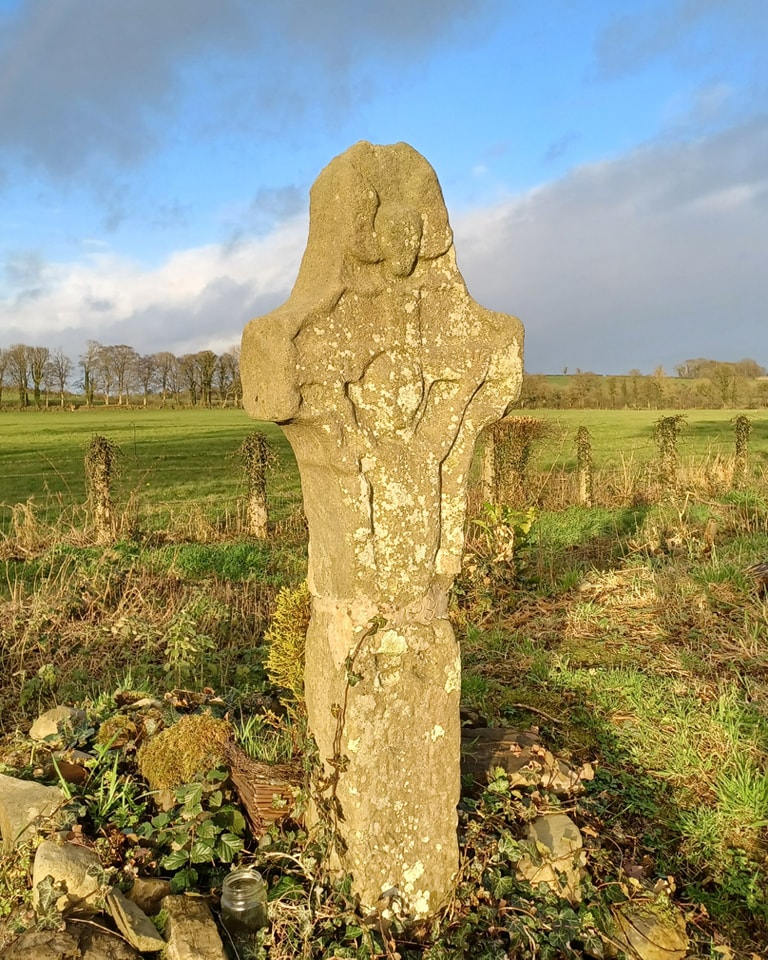
Aside from the grave slabs, the only other significant feature is a stone cross with an inscription dating to 1685, found in the laneway leading into the graveyard. The inscription reads: ‘SOVERAIN LORD KING JAMES THE SECOND BY THE GRACE OF GOD’.
This refers to James II, King of England, Ireland, and Scotland, who was deposed by William of Orange during the ‘Glorious Revolution’ of 1688. He fled to France, and then to Ireland to raise an army, promising religious tolerance to both Catholics and Protestants. James, however, was defeated at the Battle of the Boyne, leading to many Hiberno-Norman families like the Barnwalls and Plunketts having their land forfeited.
Legend has it that a Cromwellian settler named ‘Gutters/Gooders’ once took possession of Robertstown Castle, and gained notoriety for shooting at passersby on their way to Mass from the castle window. Gutters was finally shot by a priest and is said to be buried in Mullaghvally. Locals would thrown a stone over his grave every time they passed to prevent him from rising.
* ‘GAN GAN EAGLE’ is potentially an old Irish spelling of ‘Gan eagla’ (Without fear).


Sources
National Monuments Service, Monument ME011-005002, Available at https://maps.archaeology.ie/HistoricEnvironment/ (July. 19, 2025)
National Monuments Service, Monument ME011-006, Available at https://maps.archaeology.ie/HistoricEnvironment/ (July. 19, 2025)
Abraham Kennedy, ‘Upward Mobility in Later Medieval Meath’ in History Ireland Magazine, Features, Issue 4 (Winter 1997), Medieval History (pre-1500), Medieval Social Perspectives, Vol. 5
B.J. Graham, ‘Anglo-Norman Settlement in County Meath’ in Proceedings of the Royal Irish Academy: Archaeology, Culture, History, Literature Vol. 75 (1975), pp. 223-249
Robert C. Simington (ed.), The Civil Survey, A.D. 1654-1656. Vol. 5: County of Meath, with the returns of tithes for the Meath baronies. Irish Manuscripts Commission, Dublin Stationary Office (1940), p. 357
Jack Fitzsimons, The Parish of Kilbeg (Kells, 1974), p. 263
Dúchas, National Folklore Collection, ‘The Schools’ Collection’, Volume 0705, Page 329
 Beyond the Borora