
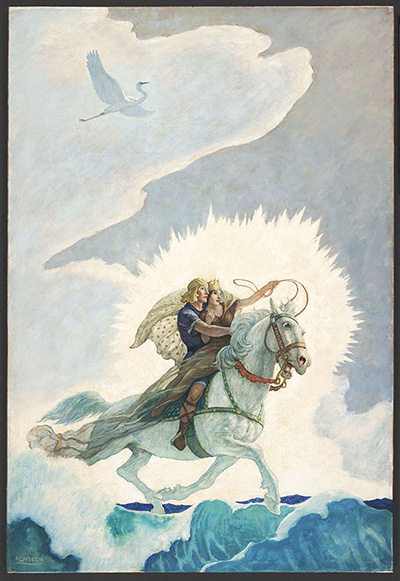
Aos Sídhe [ees-she] is the name given to the descendants of the Tuatha Dé who retreated into the different hills and mounds (sídhe) after the war with the Milesians. They can also be found living beneath certain trees (usually hawthorn), lakes, rivers and bogs.
Following the Battle of Tailteann, Bodb Dearg was chosen as king of the Tuatha Dé and led them underground into the sídhe, while Manannán Mac Lir led others to a collection of islands across or under the western sea. To remain hidden from humans Manannán thought the Aos Sídhe how to use the Feth Fiada – a magic mist which rendered everything it touched invisible. The most famous of the islands is Tir na nÓg (The land of youth), but there are other lesser known islands such as Mag Mell (The plain of honey) and Emain Ablach (The isle of apples). Although humans could occasionally visit these locations it is not known if the Irish joined the gods there after death or dwelt in the ‘House of Donn’. Donn was the Irish Lord of the Dead and it was believed that the House of Donn (Bull Rock, Cork) was where our ancestors went before the introduction of Christianity.1
Many of the stories we were taught at school like the Children of Lir and Oisín & Niamh involve members of the Aos Sídhe. Although in modern literature they are incorrectly referred to as ‘fairies’, the Aos Sídhe originally appeared quite differently and were often presented in human form.2 W.B. Yeats, who wrote extensively on the topic, explained their reduction in stature by noting that when the Gods were:
“no longer worshiped or fed with offerings, dwindled away into the popular imagination and are now only a few spans high” 3
In later times, it was thought that the Aos Sídhe also lived beneath ringforts which gave rise to the popular term ‘Fairy Fort’. There are countless tales in Irish folklore, like one set in Billywood, of people destroying these forts only to be cursed or punished in return. Yeats categorized the Aos Sídhe into two different groupings: Trooping Fairies and Solitary Fairies. Out of the two, it was the solitary variety who were more prone to mischief and particular care needed to be taken at Beltane and Samhain when the door between our worlds opened. Like in another story, this time set in Ardamagh, it wasn’t uncommon for fairies to kidnap humans during these times or even take them as lovers. As in the most mythologies of most countries the offspring of fairies and humans often led short but highly accomplished lives. Lady Gregory noted that there was an old folk belief that those skilled at the arts, such as music, were descended from the gods; whereas those skilled at fighting were descended from the Gael.4
References
- Dáithí Ó hÓgáin, The Sacred Isle: Belief and Religion in Pre-Christian Ireland (Woodbridge and Cork, 1999), pp. 58-59
- Sharon Paice MacLeod, Celtic Myth and Religion: A study of traditional belief, with newly translated prayers, poems and songs (Jefferson and London, 2012), p. 148
- W.B. Yeats, ‘The Trooping Faeries’ in Fairy and Folk Tales of the Irish Peasantry (London, 1888), p. 1
- Lady Augusta Gregory (1905), Gods and Fighting Men: The Story of the Tuatha de Danaan and of the Fianna of Ireland (The Floating Press, 2012), p. 99
 Beyond the Borora