
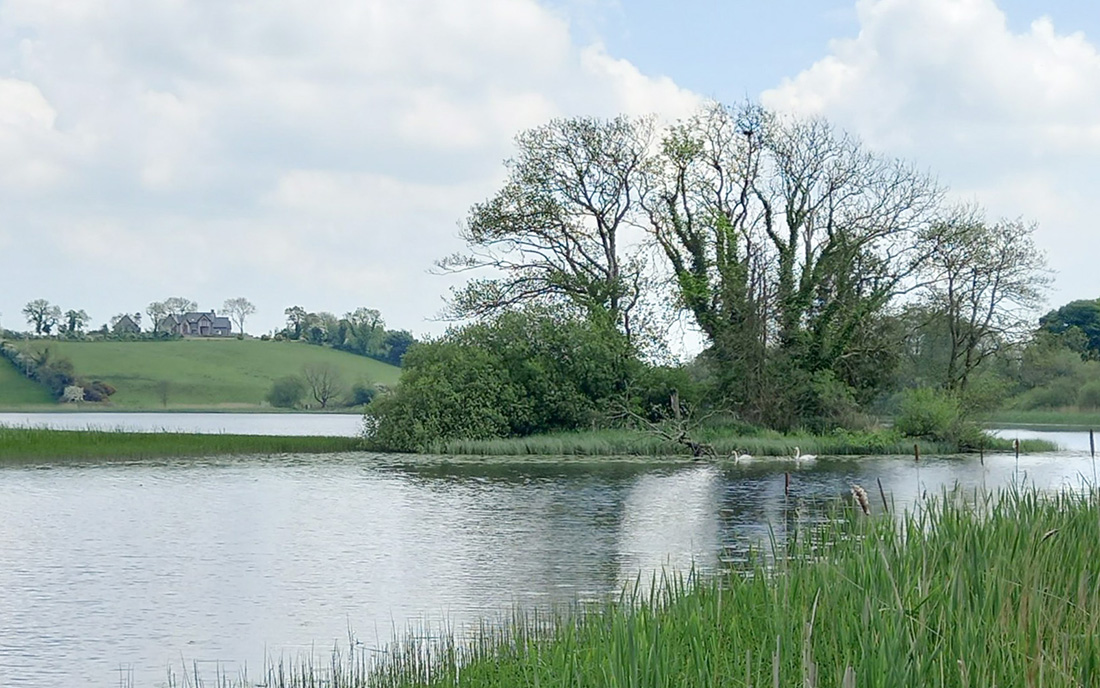
Crannogs were dwellings situated on man-made islands near the shores of smaller lakes or bog land. Primarily found in Ireland and Scotland, the dates of their construction can vary greatly over thousands of years. However, most Irish examples seem to have been built between 600 and 1000 AD,1 or were reoccupied during that period. Today, there are roughly 1,200 crannogs in Ireland,2 including four in our immediate locality.
Due to the considerable resources required to construct crannogs, they were probably the dwelling places of nobles and their immediate families. However, they could also function as meeting places for assemblies, sites for metalworking, or simply as defended storage areas for valuables. Building methods varied, but a common technique involved driving timber piles into the lake bed in a circular shape, which was then filled with large stones and layers of clay, peat, or brush until a level platform was achieved. High palisade walls weren’t always necessary for protection but were present on the royal crannogs at Lagore and Lough Ennell, associated with the kings of Brega and Mide, respectively.
Whitewood has a total of three crannogs in or around the lake, and interestingly, three dugout canoes were discovered at the Altmush site during the 1950s when the water level lowered.3 In addition, the nearby townland of Coole has been suggested as the chief site of the Fir Cúl in earlier times,4 and the presence of a crannog, large enclosure, and early ecclesiastical site certainly adds weight to that argument. Furthermore, the crannog on Ervey Lake produced early medieval pins, and given its location, may have been an important site for the Gailenga people.5 A little further away in Virginia, the Gailenga were also said to operate from a crannog on Lough Ramor.6
The largest crannog in the area at 40m in diameter was excavated at Moynagh Lough, Nobber. The site has a history spanning thousands of years but during the 7th and 8th centuries it was associated with the Mugdorna in Brega.7 Around the same period there is evidence of extensive industrial work such as metalworking and quern stone manufacturing. Like the royal crannogs mentioned earlier, Moynagh crannog was also defended by a palisade wall and housed large circular buildings, one of which was double-walled and 7.5m (25 feet) in diameter.8
References
- Aidan O’ Sullivan, ‘Exploring past people’s interactions with wetland environments in Ireland’ in Proceedings of the Royal Irish Academy: Archaeology, Culture, History, Literature, Vol. 107C (2007), p. 164
- Aidan O’ Sullivan, Crannogs: Lake-dwellings of early Ireland (Dublin, 2000), p. 12
- George Eogan, ‘Recent Crannog discoveries in Meath’ in Ríocht na Mídhe, Vol. 1, No. 3 (1957), pp. 50-57
- Whitley Stokes (ed.), The Tripartite Life of Patrick: With Other Documents Relating to that Saint, Vol. 2 (London, 1887), p. 634
- Patrick Gleeson, ‘Luigne Breg and the origins of the Uí Néill’ in Proceedings of the Royal Irish Academy: Archaeology, Culture, History, Literature (2017), p. 12
- The Annals of Ulster, Year 847.3, Available at https://celt.ucc.ie (Mar. 22, 2022)
- George Eogan, ‘Early Christian Knowth and the Kingdom of Brega’ in Eolas: The Journal of the American Society of Irish Medieval Studies, Vol. 4 (2010), pp. 12-25
- John Bradley, ‘Excavations at Moynagh Lough, Co. Meath’ in Journal of the Royal Society of Antiquities Ireland, 121 (1991), p. 22
 Beyond the Borora