
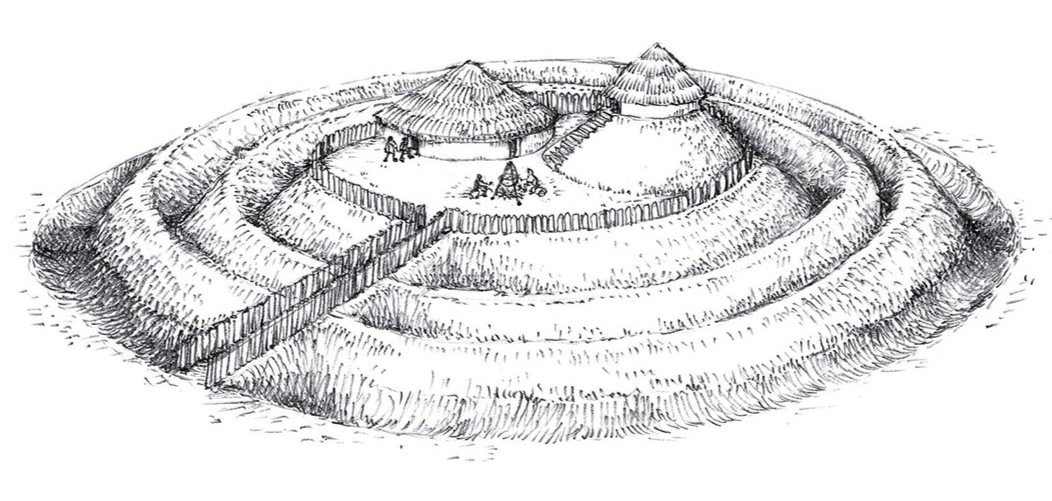
Although the site has not been fully excavated, it has been suggested that Rath Airthir is the probable location for the royal assembly at Tailteann, and so would most likely have housed a large feasting hall for festivities. The mound is actually a barrow and not a Norman motte, which due to its size it has sometimes been called, though it is possible that it housed a building as illustrated here. A footbridge has been added as there is no evidence of a causeway across the ramparts.
Rath Airthir, located near Oristown, is a trivallate enclosure associated with the kings of Brega. The Síl nÁedo Sláine ruled from here, who were in earlier times the dominant Southern Uí Néill dynasty.
Although the Hill of Tara was considered the principal site in Brega, this was mensal land controlled by the High King, therefore Rath Airthir acted as a more localised site of kingship for the Síl nÁedo Sláine. Along with the neighbouring monuments of Rath Dubh and the Knockauns, Rath Airthir also played an important role as an assembly place during the Óenach Tailteann (later, Tailteann Fair). It is not known if anyone physically resided there on a permanent basis, but the enclosure likely had it’s roots in the pre-Christian era and was a fundamental part of the Celtic royal complex of Tailteann.1 An 11th century poem in the Metrical Dindshenchas mentions that there were eight ‘royal raths’ 2 at Tailteann, so one of these may have been where the local king actually lived, while Rath Airthir retained a ceremonial function.
Of the Síl nÁedo Sláine septs, the Uí Chonaing were mentioned as rulers here before they pushed east and usurped the petty kingdom of Ciannachta, thereafter ruling northern Brega from Knowth. When the Uí Chonaing relocated, Rath Airthir was taken over by another sept, the Síl nDlúthaig (Fir Cúl), who appear to have frequently supported the Uí Chonaing militarily.3 Rath Airthir then acted as the focal point of the Kingdom of Fir Cúl from the late 8th and 9th centuries, with its borders stretching across the modern baronies of Upper & Lower Kells4 to the foothills of the Loughanleagh mountains near Tierworker. The original capital of Fir Cúl may have been at Kilmainhamwood and was ruled by the Uí Seagain,5 but these were either no longer in power or replaced by the Síl nÁedo Sláine when the Uí Neill conquered Meath.
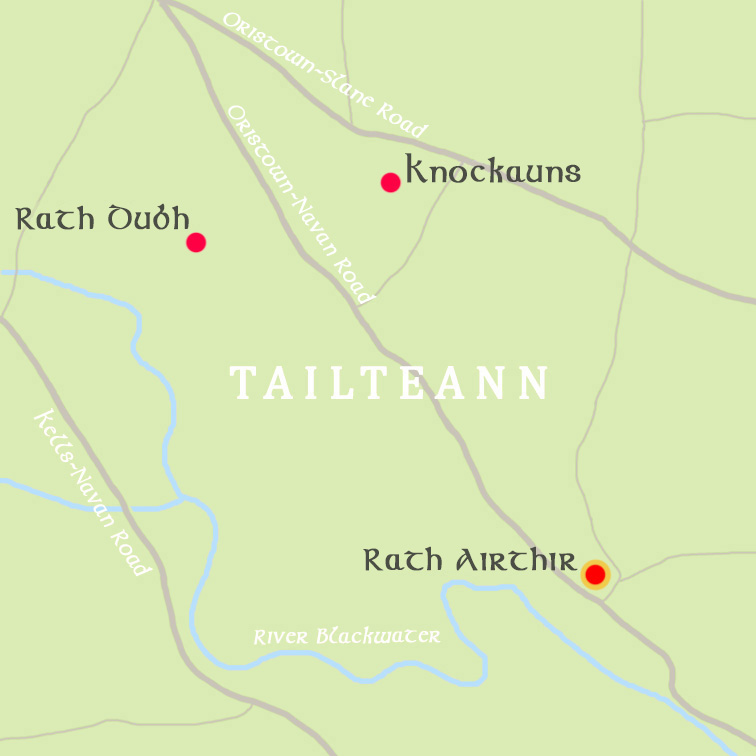
Situated next to Rath Airthir is Donaghpatrick Church, which in earlier times was an important ecclesiastical site in Brega. Conall, brother of High King Laoghaire mac Néill, granted land to St. Patrick here to build the church following his baptism.6 The church was burned or plundered six times between 745 and 1156AD, mostly by the Vikings but on the last occasion by Dermot McMurrough of Leinster.7 While Donaghpatrick was important to Síl nÁedo Sláine as a whole, their sept – Síl nDlúthaig – were more associated with the church at Tuilén (Dulane), but this more or less fell into obscurity after the foundation of Kells by the Clann Cholmáin.8
References
- Michael Herity, ‘Motes and Mounds at Royal Sites in Ireland’ in The Journal of the Royal Society of Antiquaries of Ireland, Vol. 123 (1993), p. 143
- Paul Gosling, ‘Teltown, Co. Meath: Máire MacNeill’s ‘principal old road’ and the topography of Óenach Tailten’ in The Journal of Irish Archaeology, Vol. 25 (2017), p. 71
- Immo Warntjes, ‘Regnal succession in early medieval Ireland’ in Journal of Medieval History, Vol. 30, No.4 (2004), p. 408
- John O’ Donovan, Annals of the Kingdom of Ireland by the four masters, from the earliest period to the year 1616, Vol. 1 (Dublin, 1848), p. 416
- Whitley Stokes (ed.), The Tripartite Life of Patrick: With Other Documents Relating to that Saint, Vol. 2 (London, 1887), p. 613
- Catherine Swift, ‘The local context of Oenach Tailteann’ in Riocht na Midhe, Volume 11, (2000), p. 25
- Anthony Cogan, The diocese of Meath ancient and modern, Vol. 1 (Dublin, 1862), p. 131
- T. M. Charles-Edwards, Early Christian Ireland (Cambridge, 2004), p. 273
 Beyond the Borora