
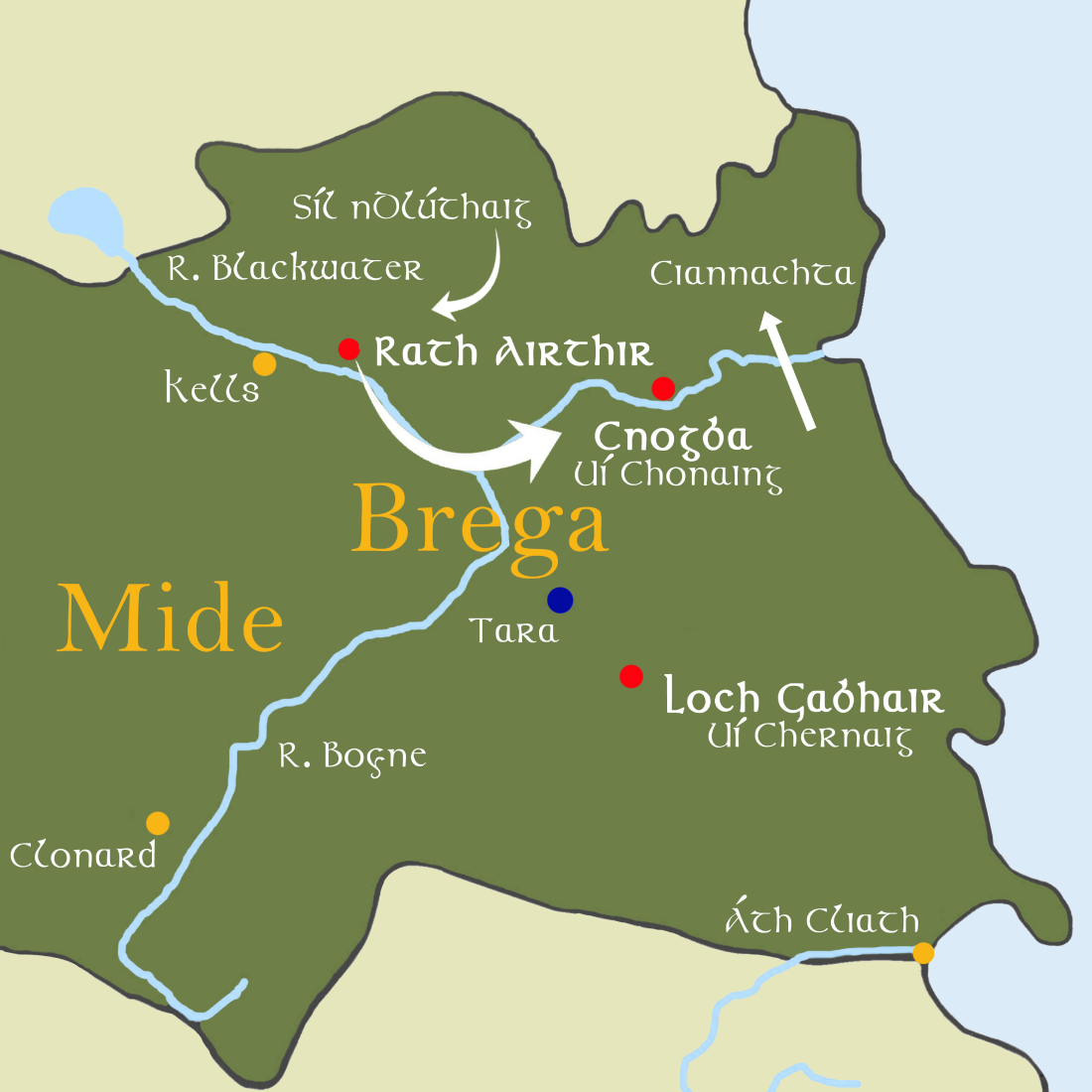
Of the major Southern Uí Néill families, there were the Clann Cholmáin and the Síl nÁedo Sláine. The latter took their name from Áed Sláinne, a 6th century High King from Slane. Upon Áed’s death, his five sons and their descendants carved up Brega between them into a number of smaller petty kingdoms. One of these petty kingdoms was called the Kingdom of Fir Cúl Breg and it spanned from Kells, through Emlagh, to Moybologue.1 It was established in the early 600’s2 and was ruled by the Síl nDlúthaig sept.
Originally the Síl nÁedo Sláine were ruled from Rath Airthir, Oristown, however there was an intense rivalry for kingship between the local Uí Chonaing family and the Uí Chernaig of Lagore. This resulted in the Battle of Imlech Pich (Emlagh)3 in 688 which effectively divided Brega in two. The Uí Chonaing pushed east and assumed control of the neighbouring Kingdom of Ciannachta in 742AD,4 and then relocated to Knowth around 800AD, taking possession of it from the Gailenga in the process.5 With the Uí Chonaing now based in Knowth and the Uí Chernaig in Lagore, Síl nDlúthaig assumed control of Rath Airthir and used it to rule their own petty kingdom of Fir Cúl.
Síl nDlúthaig had a long running feud with the Clann Cholmáin kings of Mide which led to the Battle of Bile Tened in 714AD, and just 4 years later they would yet again be at war as they became embroiled in the ongoing feud between the Uí Chonaing and Uí Chernaig. They sided with their northern kinsmen once more but both were defeated at the Battle of Kells in 718AD.6 Though in reality it was little more than a tuath, Fir Cúl was noted as being a ‘warlike’7 kingdom that was capable of competing with the bigger powers in the region.
The frequent internal conflicts between the various Síl nÁedo Sláine factions in Brega severely diminished their power, and after the collapse of Síl nDlúthaig in the mid-9th century8 the Kingdom of Fir Cúl was taken over by the Gailenga.
Fir Cúl in Mythology
Although an actual kingdom called Fir Cúl Breg was established in the 600’s, references to a tribe of the same name stretch back into Irish pre-history. In the Geneamuin Chormaic, the Fir Cúl were a Connacht people who accompanied Cormac Mac Airt on his way to Tara to claim the high kingship circa the 3rd century.9,10 They appear again, this time around the 5th century, in the Tripartite Life of St. Patrick where the saint is said to have blessed the people of ‘Ráith Cúle’ (as in ‘The Fort of the People of Fir Cúl’) and the ‘Huí Segain’.11 It has been suggested that the Ráith Cúle mentioned here might have been located in the townland of Coole in Kilmainhamwood,12 where a rather large enclosure still exists, and the Uí Segain were the ruling clan at the time.

References
- John O’ Donovan, Annals of the Kingdom of Ireland by the four masters, from the earliest period to the year 1616, Vol. 1 (Dublin, 1848), p. 297
- Paul Mac Cotter, Medieval Ireland: territorial, political and economic divisions (Dublin, 2014), p. 203
- George Eogan, ‘Early Christian Knowth and the Kingdom of Brega’ in Eolas: The Journal of the American Society of Irish Medieval Studies, Vol. 4 (2010), p. 13
- The Annals of Ulster Year 742.7, Available at https://celt.ucc.ie (Jan. 31 2022)
- Peter Harbison and Tom Kelly, Treasures of the Boyne Valley (Dublin, 2003), p. 152
- T. M Charles-Edwards, ‘Irish warfare before 1100’ in T. Bartlett and K. Jeffery (eds) A Military History of Ireland (Cambridge, 1997), p. 30
- Laurance J. Maney, ‘Rethinking the Political Narrative of Medieval Ireland: The Hagiographer as Witness’ in Proceedings of the Harvard Celtic Colloquium, Vol. 15 (1995), p. 104
- Mac Cotter, Medieval Ireland: territorial, political and economic divisions, p. 203
- Edel Bhreathnach, Tara: A Select Bibliography (Dublin, 1995), p. 136
- Maney, ‘Rethinking the Political Narrative of Medieval Ireland: The Hagiographer as Witness’, p. 91
- Whitley Stokes (ed.), The Tripartite Life of Patrick: With Other Documents Relating to that Saint, Vol. 2 (London, 1887), p. 613
- Stokes, The Tripartite Life of Patrick, p. 634
 Beyond the Borora