
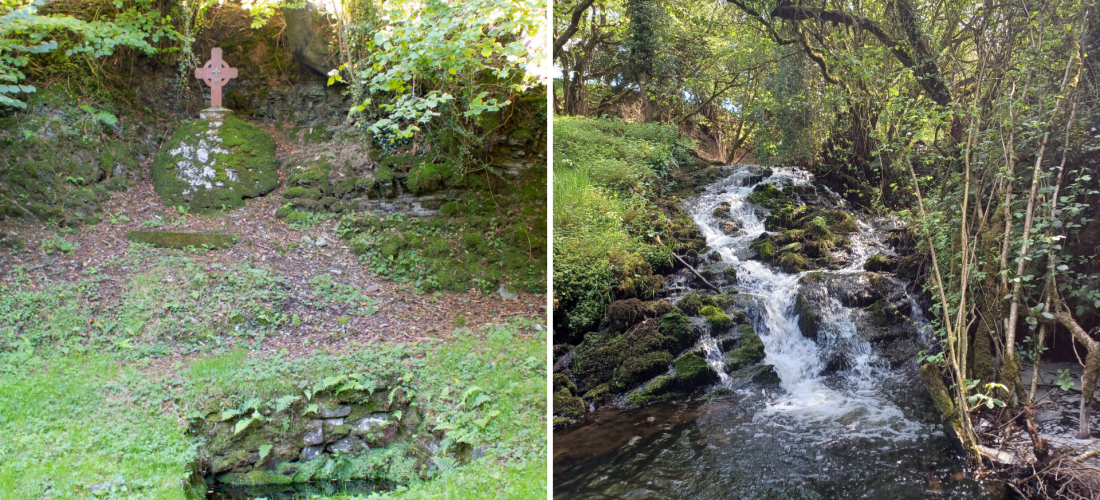
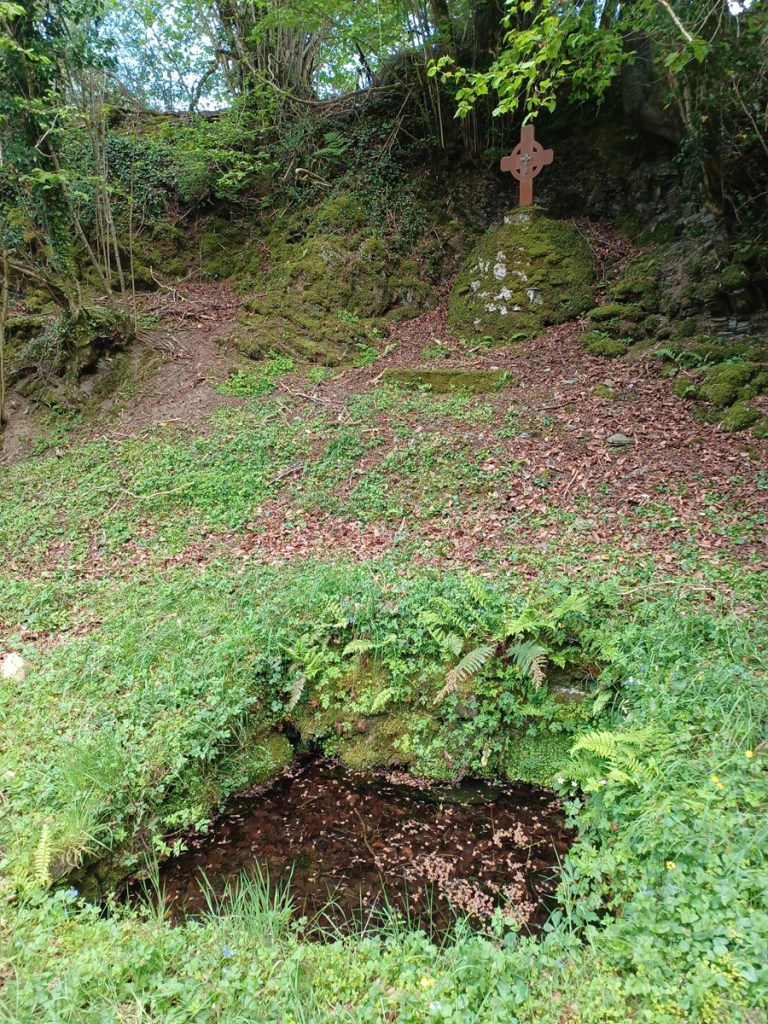
Shancor Holy Well is tucked into a quiet glen just off the ‘New Line Road’ between Kilmainhamwood and Tierworker, Co. Meath. Also known as Killfannin Well or St. Patrick’s Well, it has long been a focus for local devotion, with traditions linking it to the curing of warts, toothache, eye ailments, and even illness in cattle.
Visitors often followed established rituals at holy wells, such as completing “rounds” around the site, offering prayers, or leaving small tokens. While these practices later became part of Christian tradition, their connections to older Gaelic seasonal festivals and the belief in the water’s healing properties point to the earlier pagan origins of many of these sites.
By examining local folklore, historical references, and the practices observed at other Irish holy wells, it’s possible to piece together the ritual that would have taken place at Shancor.
The Ritual
1. Arrival:
People typically came on the first Sunday of August (Pattern Day), but also on the traditional Gaelic quarter days—Imbolg, Bealtaine, Lughnasa, and Samhain.
2. Doing the Rounds:
Approach the well, stopping at each of the four sides where crosses once stood. At each side, kneel down and say the Rosary or some personal prayers. The ‘Stations of the Cross’ were recited on quarter days. Make sure to move clockwise (deiseal) around the well, as moving anticlockwise (tuathal) is thought to invoke a curse. In most rituals, pilgrims should circle the well three times, or in multiples of three (6, 9, etc.)
3. Make an offering:
After completing the rounds, throw a small item into the well as an offering. This might be a pin, needle, medal, or coin.
4. Seeking the cure:
For warts:
- Stick a needle directly into the wart.
- Throw the needle into the well.
For a toothache:
- Retrieve a needle from the well.
- Stick it gently into the affected tooth.
- Return the needle to the well, placing it back with the pointed end facing up.
For general ailments:
There’s no specific instructions, but water is generally applied to the affected area. At nearby wells, such as at Carnaross, the water is drunk. Water from Shancor well can also cure sickness in cattle.
- Watch a video of the ritual on Facebook
- Watch a video of the ritual on TikTok
- Watch a video of the ritual on Instagram

Sources
Tamlyn McHugh, ‘Our ancient landscapes: Holy wells in Ireland’ for The Heritage Council (2023), Available at https://www.heritagecouncil.ie/publications (May 20, 2025)
Danny Cusack, Kilmainham of the Woody Hollow, Kilmainhamwood Parish Council (1998), pp. 90-91
Marion McGarry, Irish Customs and Rituals: How Our Ancestors Celebrated Life (Orphen Press, 2021) pp. 122-26
Seamus MacGabhann, ‘Landmarks of the people: Meath and Cavan places prominent in Lughnasa mythology and folklore’ in Riocht na Midhe 11 (2000), pp. 221-222
Brian Callaghan, “Shancor Holy Well,” Ireland’s Holy Wells County-by-County, Available at https://ihwcbc.omeka.net/items/show/68 (May 20, 2025)
Noel French, ‘Meath Holy Wells’, Available at https://meathhistoryhub.ie/holy-wells/ (May 20, 2025)
Irishidentity.com (2004), ‘Kilmainhamwood’s Holy Well’, Available at http://www.irishidentity.com/extras/wayoflife/stories/holywell.htm (May 20, 2025)
“The Schools’ Collection, Volume 0707, Page 077” by Dúchas © National Folklore Collection, UCD is licensed under CC BY-NC 4.0. Available at: https://www.duchas.ie/en/cbes/5008984/4973787/5110000 (May 20, 2025)
“The Schools’ Collection, Volume 0705, Page 368” by Dúchas © National Folklore Collection, UCD is licensed under CC BY-NC 4.0. Available at: https://www.duchas.ie/en/cbes/5008979/4973165/5112598 (May 20, 2025)
 Beyond the Borora