
The Bruce Invasions, or Scottish Invasions, of Ireland took place between 1315 and 1318. Robert de Bruce, who you probably know if you’ve ever seen Braveheart, had just won a famous victory against the English at Bannockburn when he received a letter from the King of Tyrone, Domhnall O’Néill. O’Néill and de Bruce already knew each other, so when O’Néill found himself wedged between aggressive Gaelic and Norman lords, he wrote to de Bruce and asked for help in securing his kingdom. In return, he offered de Bruce the high kingship of Ireland.
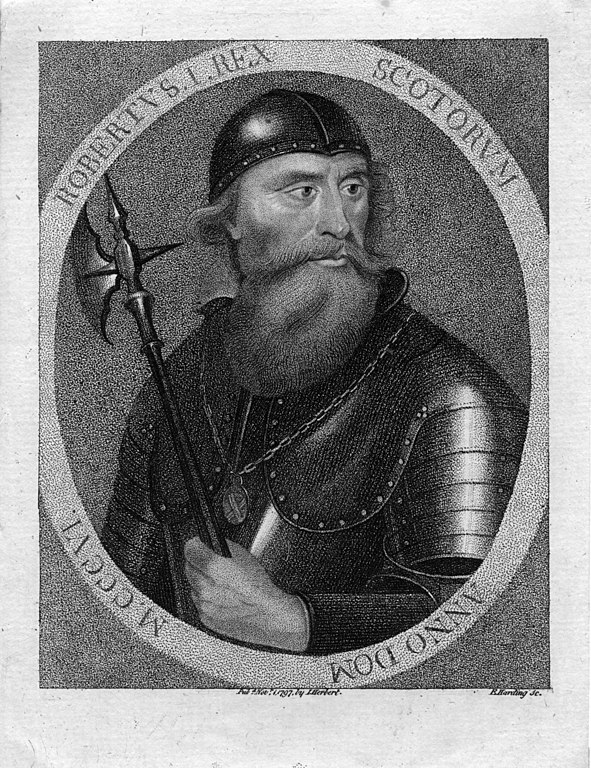
Scotland was involved in its own war of independence with England at this time, so Robert would have seen this as a good opportunity to draw resources away from the English. However, the most likely reason for accepting O’Néill’s offer was securing of a kingdom for his brother, Edward de Bruce, thereby removing a potential rival for the Scottish throne.1 Robert envisioned a ‘Celtic Alliance’ of Scottish, Irish and later Welsh peoples fighting together for independence. He wrote a letter to the people of Ireland in which he stated:
“…our people and your people, free since ancient times, share the same national ancestry and are urged to come together more eagerly and joyfully in friendship by a common language and common custom” 2
This may have been just propaganda to win over the local Irish kings, but nonetheless Edward de Bruce and an initial force of 6,000 men landed at Larne. After defeating the initial opposition led by Sir Thomas de Mandeville, Edward took the town of Carrickfergus and was joined by the forces of O’Néill and his allies and crowned High King of Ireland – a position which hadn’t been held in over 50 years, and even then it was very short lived.
A few months later reinforcements from Scotland arrived and Edward’s army marched south into Meath. The Norman lord of ‘Eastern Meath’ at the time was Roger Mortimer who controlled Trim castle. Seemingly worried that his own land around Trim would be laid to waste,3 Mortimer positioned his troops on the northern fringe of Meath in the vicinity of Kells. He may have planned to retreat into the town if needed be as he stock piled the castle there and improved the town’s defences. Edward took control of Nobber and left a contingent of troops there while advancing on Kells.
Both armies met outside the town with Mortimer having a sizable army of 15,000 men,4 however a large number of those troops belonged to his loose allies: the de Lacys. Mortimer had previously inherited de Lacy land through marriage, so in the eyes of the two de Lacy brothers, Mortimer had essentially taken what they would have seen as their ancestral land. Sometime into the battle both de Lacys withdrew their troops and fled the battlefield, leaving Mortimer to fight a larger force on his own.5 His now depleted army was completely routed and Kells burned to the ground, though he and a handful of supporters did manage to escape to Dublin. The de Lacys then seem to have joined with Edward de Bruce’s army and accompanied him on his exploits throughout the midlands.6 The war raged for another 3 years until de Bruce was finally defeated at the Battle of Faughart, near Dundalk.
The invasion took place at the worst possible time, during the European famine of 1315-1317. In order to feed his troops, de Bruce confiscated what little food there was from the local Irish (who were already sceptical of another foreign king) and so could never gain the complete support of the population. Although the invasion ultimately failed, it did serve its purpose in aiding Scotland’s war effort, and many Gaelic Irish kings did end up reclaiming some of their land. However, with the devastation brought to the countryside, both the Gaels and Hiberno-Normans alike were glad to see the back of the de Bruce.
References
- Chris Chevallier, ‘Mapping and measuring the impact of the Bruce invasion’ in History Ireland Magazine, Features, Issue 5 (Sep/Oct. 2019), Vol. 27
- G. W. S. Barrow, Robert Bruce (California, 1965), p. 434
- Ian Mortimer, The Greatest Traitor: The life of Sir. Roger Mortimer, Ruler of England 1327-1330 (London, 2010), p.70
- Patrick Weston Joyce, A Concise History of Ireland, 1910, Available at https://www.libraryireland.com/JoyceHistory/Bruce.php (Mar. 1, 2022)
- Sean Duffy, ‘Bruce, Edward’ in Medieval Ireland, An Encyclopaedia (Oxford, 2005), p. 86
- Mortimer, The Greatest Traitor, p.71
 Beyond the Borora