
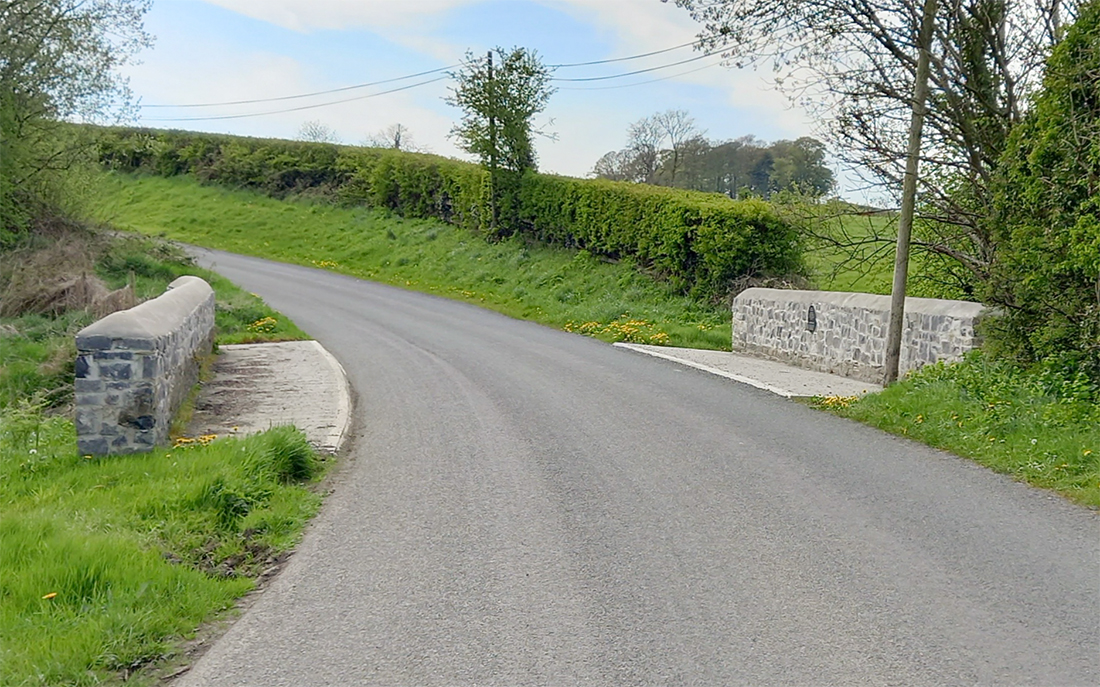
Before the outbreak of the War of Independence there were numerous units of Volunteers scattered throughout Meath. These were reorganised in 1917 and a newly structured Meath Brigade was formed. Between 1917-1920, the IRA units in northern Meath made up the 4th (Kells) Battalion. In 1921, another restructuring saw the 4th Battalion become the 1st (Newcastle) Battalion of the 3rd Meath Brigade. This had strength of 245 Volunteers.1
| A Company Newcastle | B Company Moynalty | C Company Kells |
| D Company Nobber | E Company Kilbeg | F Company Milltown/K’wood |
| G Company Mullagh | H Company Drumcondrath | I Company Meath Hill |
What is quite apparent is that for the duration of the war there was considerable cooperation between the companies in the neighbouring villages. In October 1920, a planned attack on Nobber R.I.C barracks involving various companies was called off, however the barracks in Moynalty (which is now Deignan’s shop) was burnt out a couple of months later and the Courthouse demolished. In December 1920, Moynalty IRA blew up the bridges at Moynalty, Carlanstown and Mahonstown with the assistance of Newcastle and Mullagh companies.2 Earlier in the year Kilmainhamwood IRA had also used explosives to destroy the recently deserted RIC barracks.3 Nobber barracks was targeted again just before the truce came into effect in 1921. On this occasion a gun battle with the RIC ensued for over 30 minutes.4
Following the war, between 1947-1957, the Irish government took witness statements from selected survivors of the period. According to the statement by Pat Reilly,5 Captain of Moynalty Company, in January 1921 a number of weapons and explosives were being stored in a house near Salford Bridge on the Moynalty-Kilbeg road. The owner of the house, who then lived in Mullagh, called in to visit the property with a friend and noticed that the clay on the ground had been disturbed. That night he went for a drink and happened to mention in the pub that he thought a body was buried there. As it turned out, there was an informant in the pub who tipped off the authorities.

The following Sunday as parishioners were on their way to Mass a number of R.I.C and ‘Tans’ arrived at the scene and commandeered some of the locals to dig up the weapons. Upon hearing the news, Captain Reilly rounded up local Volunteers Jimmy Curran, Michael Govern and Pat Farrelly and headed for Salford. By now some of the police had begun to search a nearby vacant house, so Moynalty Company opened fire while their forces were divided. They engaged the RIC long enough for reinforcements to arrive, in the form of Frank Clarke, Michael Reilly, Ned Govern and Pat Sheridan. The R.I.C retreated leaving their car, the explosives and a number of their own weapons behind.
In the aftermath of the battle the car was stripped for parts and then burnt out, while the explosives were handed over to Newcastle Company for safe keeping. In the witness statement of Michael Govern,6 mentioned above, he states that most of the Volunteers involved in the attack had to go on the run afterwards. They set up a ‘Flying Column’ and operated out of a disused house in Rosemount, near Newcastle.
References
- Defence Forces of Ireland, Military Archives, Military Services Pension Collection, RO/489, Available at https://www.militaryarchives.ie/ (Jun. 28, 2022)
- Defence Forces of Ireland, Military Archives, Bureau of Military History (1913-1921), ‘Statement by Witness W.S 1650’, p. 15, Available at https://www.militaryarchives.ie/ (Jun. 28, 2022)
- Ultan Courtney, ‘The Blinding Light’, (Ultan Courtney, 2014), p. 175
- Padraig Óg Ó Ruairc, ‘The Anglo – Irish Truce: An analysis of its immediate military impact, 8-11 July 1921’, PHD Thesis, University of Limerick (September, 2014), p. 185
- Defence Forces of Ireland, Military Archives, Bureau of Military History (1913-1921), ‘Statement by Witness W.S 1650’, 24 pages, Available at https://www.militaryarchives.ie/ (Jun. 28, 2022)
- Defence Forces of Ireland, Military Archives, Bureau of Military History (1913-1921), ‘Statement by Witness W.S 1625’, p. 6, Available at https://www.militaryarchives.ie/ (Jun. 28, 2022)
 Beyond the Borora