
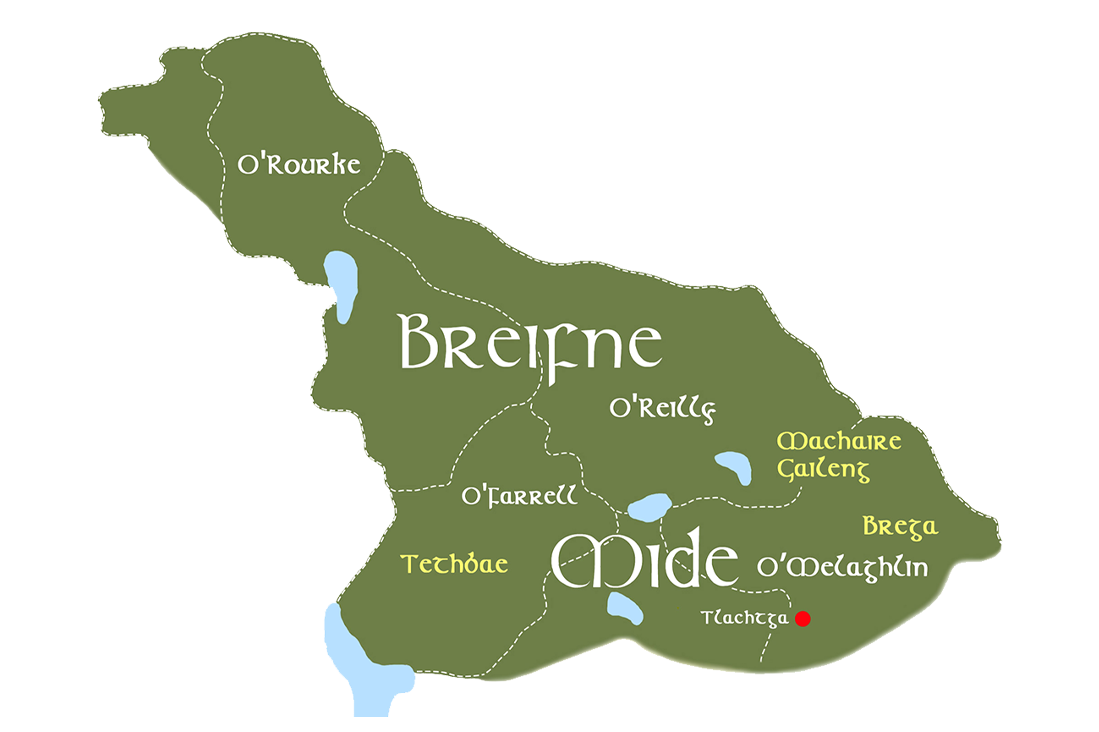
The ancient Gaelic kingdom of Breifne encompassed much of what is now counties Cavan and Leitrim, along with parts of the surrounding counties. After the fall of the Clann Cholmáin of Mide, Breifne expanded to include most of northern Meath. In 1256, the kingdom was divided into East and West Breifne following the Battle of Magh Slécht, between the O’Reillys and the O’Rourkes. The boundary that separated both parts of Breifne was the river at Ballyconnell,1 while East Breifne spanned all the way to the outskirts of Kells:
“the boundaries of the territory of Breffni O Reilly passed through Kilmainham Wood to Kells, and from thence to Crossakeel and Oldcastle” 2
The area around Moybologue was part of an ancient Breifne tuath known as ‘Fidh na Saithni,’3 the Saithni (Saithne) being a branch of the Gailenga. Fidh na Saithni was seized by Niall O’Reilly, who died at the previously mentioned Battle of Magh Slécht.4 Niall’s descendants, known as Clann Chaoich (meaning ‘Clan of the One-Eye O’Reilly), gave their name to what later became the barony of Clankee.
There was initially a positive relationship between the Normans and East Breifne. Being on the fringe of the Gaelic kingdoms to the north, the Normans to the south, and an aggressive West Breifne, East Brefnian kings had to adopt a position of allying with different sides depending on the circumstances. This relationship of convenience, however, broke down when the de Lacys began to exert their control in the region and built Cloughoughter Castle on the site of an older O’Reilly crannog.5 The castle was later captured by the O’Reillys and served as one of their chief seats of power before moving to Tullymongan in the late 1300s.6
During the Gaelic resurgence of the 15th century, Clann Chaoich expanded their territory into Meath. This led to a dispute with the O’Reilly chieftain, Toirdhealbhach O’Reilly, and the Clann Chaoich were eventually confined to the northern part of their land, known as Clann Chaoich an Fheadha, around Bailieborough and Shercock.7
Following an internal rebellion in 1429,8 the ruling O’Reilly chief called on Tyrone for help, effectively making East Breifne vassals of Tyrone for the next 100 years. Seeking greater independence, the O’Reillys then aligned with the English administration, and in 1579, East Breifne was formally shired as County Cavan. Relations with England soured soon after this, though; English restrictions on the size of the East Breifne army left them vulnerable to attack, and the English sheriffs tasked with keeping keep law and order were known for their corruption and abuse of power.9
When the Nine Years’ War broke out in 1593, Cavan was obliged to participate on the English side but switched allegiance and joined with the Irish alliance. Brehon Law was reintroduced throughout the county and a new king proclaimed on Shantemon Hill10 – the traditional Gaelic inauguration site of East Breifne. The rebels’ defeat and subsequent ‘Flight of the Earls’ in 1607 marked the end of the kingdoms power.
References
- Geoffrey Keating, The History of Ireland from the Earliest Period to the English Invasion, translated by John O’Mahony (New York, 1857), p. 732
- Philip O’ Connell, ‘Historical notices of Mullagh and district’ in Breifny Antiquarian and Historical Society Journal, vol. 1, no. 2., (1921) p. 114
- Paul Mac Cotter, ‘The early history and sub-divisions of the kingdom of Bréifne’, in J. Cherry, B. Scott and W. Nolan (eds.), Cavan: History and Society (2014), pp. 1-25
- The Annals of Connacht, Year 1256.7, Available at https://celt.ucc.ie (Jan. 16, 2025)
- Tony Canavan, ‘Cavan County Museum’ in History Ireland Magazine, Published in Issue 5 (Sep/Oct 2014), Reviews, Volume 22
- Jonathan Cherry, ‘Colonial appropriation of Gaelic urban space: creating the first Ulster plantation town’ in Irish Geography Journal Vol. 40, Issue 2 (2007) p. 115
- Mac Cotter, ‘The early history and sub-divisions of the kingdom of Bréifne’, pp. 1-25
- Michael O’ Clery and Owen Connellan, The Annals of Ireland (Dublin, 1846), p. 234
- Calendar of the State Papers Relating to Ireland. July 1596 – Dec. 1597, ed. E.D Atkinson, Department of H. M. Public Record Office, Volume 6 (1893), p. 181
- Elizabeth FitzPatrick, Royal Inauguration in Gaelic Ireland C. 1100-1600: A Cultural Landscape Study (Woodbridge, 2004), p. 113
 Beyond the Borora