
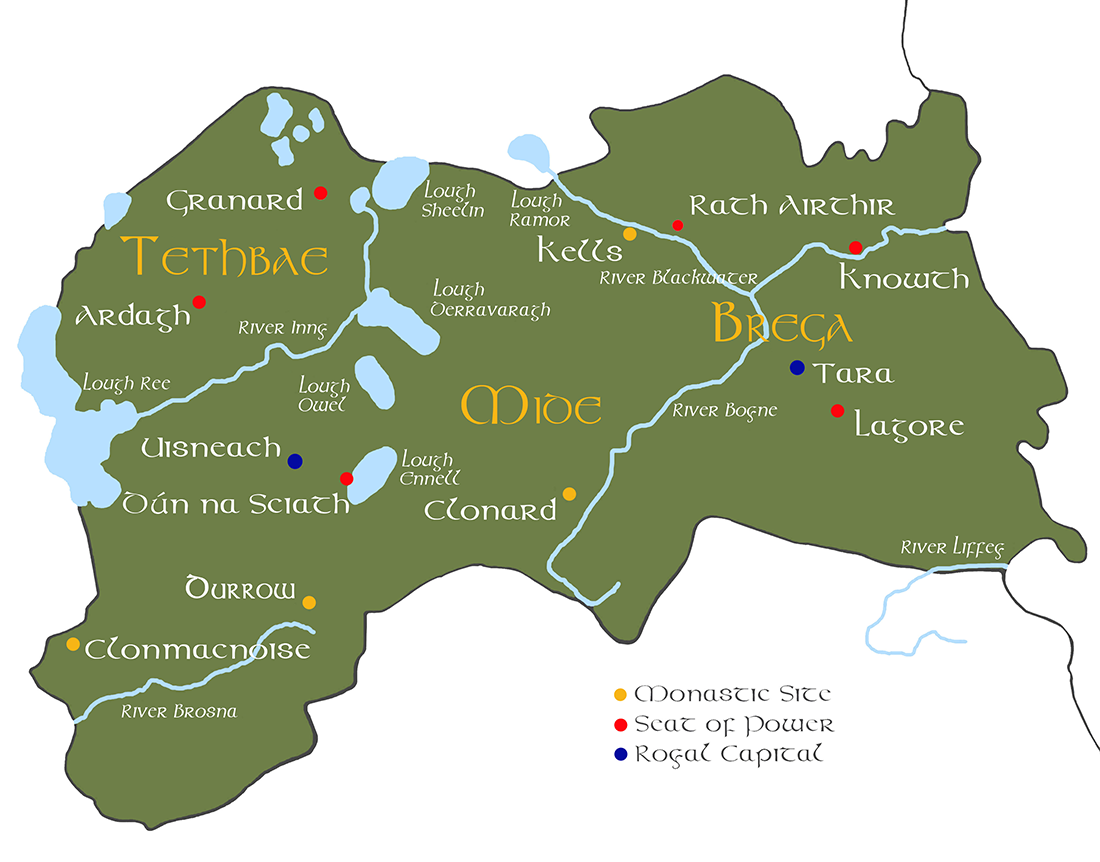
The medieval Kingdom of Mide was mostly made up of Westmeath, parts of Longford and Offaly. It later extended eastwards to include neighbouring Brega (mostly modern Meath).1 Mide and Brega were separated by a fluid border that likely shifted with the fortunes of their Southern Uí Néill rulers.2
The Hill of Uisneach was the royal capital of Mide, and according to one theory, was the original seat of the High Kings before power later shifted to the Hill of Tara.3 Uisneach and Tara were joined by a roadway and were mainly used for ceremonies, festivals and passing laws. Although they may have been used as residences for a period of time, their main function was purely as symbolic and ceremonial capitals. The Kings of Mide, the Clann Cholmáin, actually resided at Lough Ennel near Mullingar. There is a large raised ringfort here called Dún na Sciath and a nearby crannog Cró Inis which were both used by their kings.
Although Mide and Brega were part of the same ancient fifth, or ‘province,’ and their kings were distant relatives, they were frequently at war with each other, competing for the kingship of the Southern Uí Néill. Initially, the Síl nÁedo Sláine of Brega held the upper hand, but their internal conflicts allowed the Clann Cholmáin to seize control of both regions by the end of the 10th century,4 although their influence had been felt much earlier. In the early 9th century, the Clann Cholmáin gave patronage to the Columban community at Kells and were enthusiastic supporters of the Columban Church,5 which would eventually lose ground to the papal-backed Patrician Church at Armagh.
Between the 8th and 10th centuries the high kingship was dominated by members of the Clann Cholmáin and their northern counterparts, the Cenél nEógain.6 The Clann Cholmáin produced several powerful kings, most notably Máel Sechnaill mac Máele Ruanaid (Malachy 1st), who gained the submission of Munster and more or less controlled the whole island. The alternating system of kingship between the various Uí Néill clans ended when Malachy 2nd, great-great-grandson of his namesake, was forced to submit to Brian Boru in AD1002.7 This signalled the beginning of the end of the Clann Cholmáin and ended centuries of the Uí Néill monopoly on the high kingship.
By the 12th century the Kingdom of Mide, weakened by civil war, lost its northern frontier to the expanding Kingdom of Breifne and was frequently divided up amongst the other competing provincial powers.8 The kingdom ended upon the arrival of the Normans and became part of the Lordship of Meath under the control of Hugh de Lacy.
References
- Roseanne Schot, ‘From Cult Centre To Royal Centre: Monuments, Myths And Other Revelations At Uisneach’, in (eds) R. Schot, C. Newman and E. Bhreathnach Landscapes of cult and kingship (Dublin, 2011), p. 93
- Catherine Swift, ‘The early history of Knowth’ in Excavations at Knowth 4 (Dublin, 2008), p. 10
- R.A.S Macalister and R. Lloyd Praeger, Report on the Excavation of Uisneach, Proceedings of the Royal Irish Academy: Archaeology, Culture, History, Literature, Vol. 38 (1928/1929), p. 125
- Roseanne Schot, ‘From Cult Centre To Royal Centre: Monuments, Myths And Other Revelations At Uisneach’, in (eds) R. Schot, C. Newman and E. Bhreathnach Landscapes of cult and kingship (Dublin, 2011) p. 93
- T. M. Charles-Edwards, Early Christian Ireland (Cambridge, 2004), p. 273
- Immo Warntjes, ‘The Alternation of the Kingship of Tara 734-944’ in Peritia 18 (2004), 39 pages
- Seán Duffy, Atlas of Irish History (Dublin, 1997), p. 26
- Denis Casey, ‘A man of great power for a long time’ in History Ireland Magazine, Published in Features, Issue 5 (Sept/Oct 2010), Pre-Norman History, Volume 18
 Beyond the Borora