
Over the years stories of faeries and creatures from folklore were passed down from generation to generation, with many rural areas developing their own unique and wonderful variations. Not long after independence, the Free State government set about collecting these folktales in an effort to preserve the oral tradition of Ireland. Between 1937-39 a scheme was initiated by the Irish Folklore Commission known as The Schools’ Collection, in which 5000 primary schools from across the 26 counties took part in gathering stories of local traditions and lore. The majority of the stories below, unless otherwise referenced, were collected from Edengora, Maio, Moynalty, Ughtyneill, Westland, Finternagh and Ballynamona primary schools. The old national school in Kilmainhamwood was closed in 1937, and although it re-opened on a new site later that year, it seems like it missed out on being included in the Schools’ Collection.
As many of the tales are quite similar in nature, I have selected a few and organised them into chapters. These have been summarised them from their original form for clarity. The original versions, and many other similar tales, are accessible online on the Dúchas website.
| Chapter 1 Hidden Gold | Chapter 2 Monsters | Chapter 3 Ghosts |
| Chapter 4 Faeries | Chapter 5 Banshees | Chapter 6 Leprechauns |
| Chapter 7 Headless Horseman | Chapter 8 Witches | Chapter 9 Giants |
| Chapter 10 Holy Wells | Chapter 11 Mass Rocks | Chapter 12 Village Stories |
Chapter 1: Hidden Gold
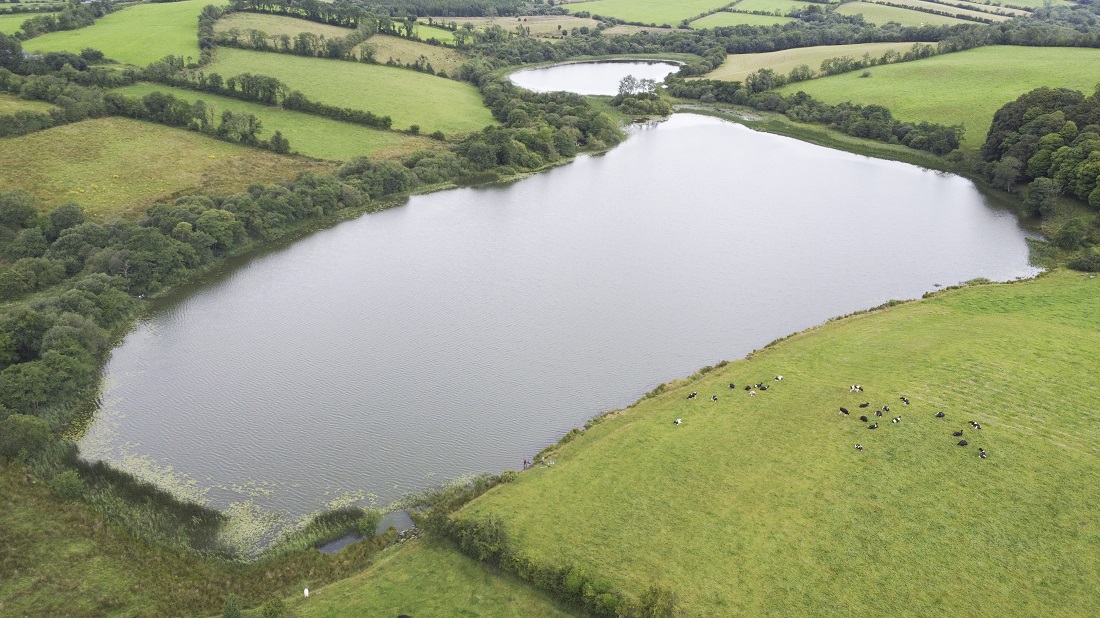
A man had a dream that a pot of gold was hidden in Billywood bog and that he was to collect it using four black horses. He was warned that if he heard any strange noises at Stirabout Hill to ignore them and don’t look back. He collected the gold, but sure enough he forgot about the warning and turned around when he heard noises. The pot of gold then rolled back into the bog and was replaced with a giant fish. (Stirabout was a type of porridge/gruel served during ‘Famine’ times. Stirabout Hill was so named as it was the site of a Famine relief scheme1). Original by Thomas Reilly, Moynalty; The Schools’ Collection, Volume 0705, p. 358
There was once a castle overlooking Breakey Lake and the hill itself was known as ‘Castle Hill’. The owner had a large keg of gold which was famous throughout Ireland. One day he heard that Cromwell was coming to steal it and to knock the castle, so he let the keg roll down into the lake where it still lies at the bottom. The was supposed to be a well on the hill too but the owner once dug down and only found a large stone with horse shoe tracks on it. It was also said that there was a cave going from this hill all the way to Oldcastle. Original by Mary Jackson, Edengora; The Schools’ Collection, Volume 0710, pp. 15-16
There was an old fort in Shancor on land owned by a Fitzsimmons man. It was said that a crock of gold was hidden there and he levelled the fort looking for it. He only had his daughter to help, him so when a tiredness came over him he decided to finish the work the following day. The next morning he discovered that his daughter had gone insane so he decided to stop digging in fear of something worse happening. He had levelled all but two ‘tow bushes’, and it’s under these bushes that you can find the gold. Original by Eileen Cusack, Corcarra; The Schools’ Collection, Volume 0710, p. 12
There are the remains of a crannog at Coolnahinch called ‘Móin na Loacha’. The bog it is in was once a lake and there is supposed to be a passageway at northwest corner that leads to a house underneath. Here you can find a crock of gold guarded by a black greyhound with a white spot on its side. The hound will run round the crock three times and in that time you have to stab him in the white spot. If you succeed you can take the gold, but if you miss you have to take his place. It was said that robbers used to use the fort as a hideout and had the water gates regulated so they could drown any pursuers. Different items were found at the fort, such as wooden cups & spoons, a gold pin and human and animal bones. Original by Michael Ó Briain, Carrickspringan; The Schools’ Collection, Volume 0705, pp. 197-198
Before there were banks people used to keep their gold and silver at home and hide it about the place. There was a man from Newcastle called Padraig Mór Lynch and he had a keg full of gold. Some thieves came to take it one day but he had the front door barred. He escaped out the back door and let the keg roll down the hill into the lake so they wouldnt get hold of it.. The lake is known locally as ‘Padraig Mór’ and the gold remains at the bottom to this day. Original by Kevin Carolan, Teevurcher; The Schools’ Collection, Volume 0709, pp. 315-316
There was once a well in Copponagh, Tierworker, that went dry. Locals went in search of a new one and found an alternative nearby where a spring rose up around a big rock. They used some dynamite to make a hold for the water and afterwards noticed a pot of gold hidden underneath. They decided to split the gold between them and brought the pot to the nearest house and left it there to be divided up the next day, but that night a “terrible crying and mourning” was heard around the house. The following night after the money was divided the same noises were heard around everybody’s house who took the gold. On the third night there were no noises, but in the morning they discovered that livestock had been killed, houses knocked, crops damaged and some of the people were sick. They quickly gathered up the gold again and left it back where they found it. Original by Vincent Gargan, Newtown; The Schools’ Collection, Volume 0710, pp. 10-11
Chapter 2: Monsters

The Whitewood Monster | A large black monster was reportedly seen on different occasions swimming in Whitewood Lake. A story featured on RTÉ in 1981 and also made the front page of the Meath Chronicle. According to one witness, Denis Naulty, the monster looked “something like a large black sow pig, very black, I would say he measured about seven feet long”. The Department of Fisheries were notified and a team of underwater divers came but were hampered by poor visibility – apparently the water was “the nearest thing to diving in stout!”.2
The Black Pig | A cruel headmaster would change his students into a hare and greyhounds and have them chase each other at playtime. One of the boy’s mothers discovered what was happening when he kept coming home from school tired every day. She also knew magic and turned the headmaster into a black pig and told him that he would run until he cut his own throat with his two front hooves. He ran through Antrim, Down, Louth and Meath and died by cutting his throat while swimming across the Boyne. Original by Patrick Reilly, Moynalty; The Schools’ Collection, Volume 0705, pp. 360-361
Garrawog | A Gargan woman was traveling to the church at Moybologue to receive communion. She was supposed to be fasting, but when she saw a bush full of blackberries along the road she couldn’t resist getting down off the side car and eating them. As soon as she did so, she turned into a monster and ate the side car, the horse and the man riding it. The people sent for St. Patrick and as soon as Garrawog saw him she raced towards him. He knelt down on the road and hit her with his staff, splitting her into three pieces. One piece went into the lake, one piece went up in the air, and another piece went into the ground. A mark on the road in the shape of St. Patrick’s knee can still be seen from where he knelt down. He said that when ninety nine generations of Gargans crossed over a stream into the graveyard Garrawog would rise again. Ever since, whenever Gargans were following a funeral towards Moybologue they would take another route so as not to cross the stream. Original by Olive McWhirter, Drumlayne; The Schools’ Collection, Volume 0706, pp. 298-299
Chapter 3: Ghosts
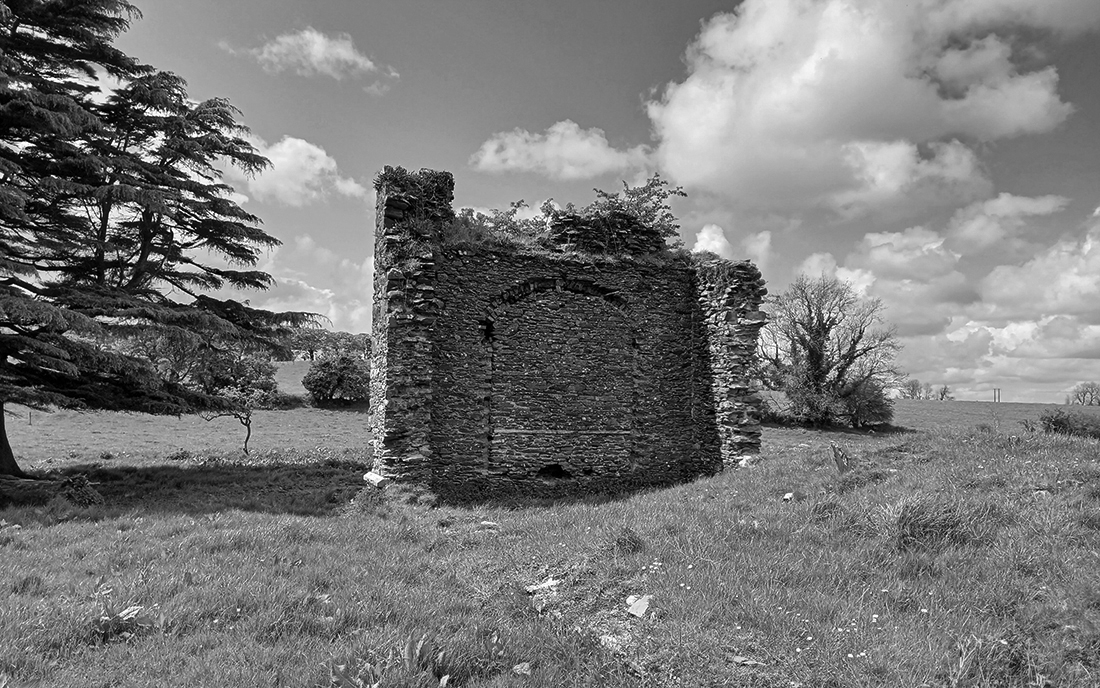
Petersville House was originally owned by a man called Martin Tucker, who sold it to a Priest Hunter called ‘Peters’. One day, Peters sent for a priest to come to the house for one of his servants who was sick. When the priest arrived to pray for the servant, Peters jumped out from under the bed and killed him. He then buried him in the cellar but could not level the grave, and the people who lived in the house after him could not level the grave either. Original by Antonie O’Concubhair, Coolnahinch; The Schools’ Collection, Volume 0705, pp. 233-234
A man called Dr. Duignan came into possession of Petersville House. The doctor knocked a wall to make two rooms into one for a nursery, but when he did so he released a ghost who would walk around the house at night in fine clothes. When the doctor would arrive home from work the ghost would be standing at the gates to let him in. The doctor initially assumed this was one of his workers but later found out that he didn’t work here at all. He was told in his sleep that he would get no peace until that room was closed off, so he got priests to say prayers from the entrance to the house and trapped the ghost back in the room. It was sealed up afterwards. A couple of years later two men looked into the room and the walls were covered in blood. Original by Antonie O’Concubhair, Coolnahinch; The Schools’ Collection, Volume 0705, pp. 188-189
Children were playing in an old house in Ballincleva and heard a strange noise out the back. Some of them went to see what it was and saw huntsmen on horseback with a pack of hounds. The huntsmen disappeared when they saw them. The house then began to shake and strange lights were seen in one room. A year later the children returned and were throwing stones through a window until a black figure in a room told them to stop. The house was later bought by O’Briens and one time a bonfire was lit outside. Everybody went into the house to dance but they were all chased out of the house by the ghost and followed up the road. The ghost appeared again to a woman called Mrs. Carrick and told her to get out of the house because it belonged to him. When Mr. Carrick returned home both of them went inside and saw the ghost vanish into the floor. Original by Patrick Brady, Moynalty; The Schools’ Collection, Volume 0705, pp. 334-335
A Clarke man from Drumbulrisk was warned not to interfere with a fort there but he didn’t listen. He cut some bushes and built a ‘rick’ of straw on it. Later that evening he was followed home by a blue light and never got up in the morning. The following year he died of a brain tumour. Nearby in Cormeen, there is another fort in called the ‘Fool’s Fort’. Two men from Ballyoughly, Kingscourt, were getting boots fixed in Maio when they saw a white figure in the gripe outside the fort on the way home. The figure began to run after them and chased them all the way back to Kingscourt. In Tiercorke, Moynalty, a man used to cut the bushes on a fort in one of his fields and every year some of his stock would die. They only stopped dying when he quit cutting the bushes. (*The ‘Fool’s Fort’ appears on the 1836 OS map but no explanation is given for its name). Original by Mrs. Bernard Conlon, Mullaghavally; Schools’ Collection, Volume 0710, pp. 87-88
Two men named Smyth and Reilly were driving a horse and cart at Feagh. The horse suddenly stopped in its tracks and a white figure approached and walked passed them. After passing, the horse continued on its way. On their way home, they saw the white figure again but this time it disappeared into a hole in the ground. There is supposedly a mark on the road from where the hole opened up. Original by Patrick Connelly, Moynalty; The Schools’ Collection, Volume 0705, p. 416
In Leitrim, Moynalty, there was an old man called ‘The Gentleman Reilly’ who had just come home from the hospital. His son was out in the fields when the old man fell asleep beside the fire. When the son returned home he found that his father had fallen into the fire and died shortly afterwards. A few days later the son seen lights outside and went out to investigate. The lights then disappeared and he saw his father in the darkness. The ghost now walks the lane that leads up to the house every night. The son eventually sold the house and the new owner reportedly saw the ghost and went insane. Original by Patrick Brady, Moynalty; The Schools’ Collection, Volume 0705, p. 426
A Kearney man was ploughing land in Corcarra when he unearthed a large flat stone. Needing a hearthstone himself, he lifted the stone not knowing that there was a ghost underneath it. On the first night he took it home a roaring noise was heard coming from the field. On the second night everyone in the district could hear the roaring. The spirit became known as the ‘Breakey Roaring Ghost’. One night a young boy had to pass the field to deliver a message and was chased by the ghost. He ran into a nearby bog to escape it and spent the whole night there. He died soon after he was found. After the boy’s death the stone was replaced and the roaring was heard no more. Original by Patrick Conlan, Mullaghavally; The Schools’ Collection, Volume 0709, pp. 322-324
Chapter 4: Faeries

A Gilsenan man from Billywood worked as a contractor planting trees in wet land near Navan. On one piece of land there were three bushes which he asked his workers to clear off. The workers refused as they were lone bushes, so Gilsenan got a hatchet and cut them down himself. The following day he put flowers in his coat and travelled throughout the country. He had lost his mind. He would even go to mass with the flowers in his clothes and he did this for nine or ten years. Eventually he became ill and a man came to see him. The man told Gilsenan’s son that his father would die that night so he would have to keep watch over him. At twelve o’clock the son heard a commotion outside and looked out the window. He saw hundreds of little men pulling his father’s body along the road. He quickly turned back around and saw that his father was dead. Original by Michael Ó Briain, Carrickspringan; The Schools’ Collection, Volume 0705, pp. 185-187
The wife of an O’Brien man from Ardamagh left the house one Halloween night and never came back. At that time there was a wise woman who would go from house to house getting lodgings. She had a pewter plate and would go out at twelve o’clock every Halloween night to collect the seed of the ‘raitnig’, which would give her foresight for the year ahead. She advised O’Brien to stand in a particular gap at twelve o’clock on Halloween night and watch for a hunt that would pass. His wife would be on horseback and if he could pull her off she would return to him, but if he missed he would never see her again. He did as the wise woman asked but when his wife passed he let her go and never saw her again. The hunt would travel from that fort to one in Halpin’s field. Original by Seán Mac an tSaoi, Ballymakane; The Schools’ Collection, Volume 0705, pp. 282-283
A Murphy man owned land at Shancor which had a fort on it. His cows would graze near the fort and every day when the last of his cows was milked, she would kick over the bucket and spill the milk. One day Murphy heard a child crying and its mother saying “Don’t cry, Murphy is late milking his cows this evening, we will have plenty of milk soon”. He took a look into the fort and saw a fairy woman with a child in her arms. Later that night he told his wife to take care from now on that no cow spills her milk. The next morning one of his cows was found dead, and soon after all of his cows had died. It was thought that the faeries would never harm him so long as he gave them milk. Original by Patrick Cusack, Corcarra; The Schools’ Collection, Volume 0710, p. 21
A Cassidy man was walking back to his house in Kilfannan after playing cards. He saw a tall thin man and some children standing at the edge of the Drumbulrisk Fort. They called him over and then pushed him inside. The fort was all lit up and a football match was being played between a team with red hats and a team with green. He watched the match for a while until the faeries disappeared and he was left standing in the middle of the fort on his own. At Kilboyne Fort, a man named Millar was traveling home one night and also saw the tall thin man with what looked like a group of children. The tall man walked with Millar for a while but when the children got too close to Millar’s dog he warned the tall man to be careful or the dog might bite them. The man replied that “He couldn’t, and you couldn’t, even if you had a knife”. The dog started whimpering after that and didn’t stop until he got home. The faeries disappeared after Millar crossed a stream. Original by Olive McWhirter, Drumlayne; The Schools’ Collection, Volume 0706, pp. 304-305
A green scum used to cover the water on Mullagh Lake once every three months. The lake was said to be enchanted and that the green scum was from when the faeiries were cleaning out the stables of their horses. A woman decided to see if the stories were true and stood by the lake one night at twelve o’clock. She was said to have been kidnapped by the faeries as she waited by the shore. Sometime later her husband was told to wait by the shore at twelve o’clock and throw in holy water when he saw ripples appearing. He did as he was told and his wife reappeared, but she had no recollection of what had happened at all. Original by Michael Ó Briain, Carrickspringan; The Schools’ Collection, Volume 0705, pp. 260-261
There was once an O’Reilly swordsman who lived on Mullagh Hill. He a caught a magical horse which had come out of the water to graze at the edge of the lake. A local British officer called Mabe had heard about how good a fighter O’ Reilly was and decided to go to Mullagh to challenge him. O’Reilly was not at home at the time, but when he heard that Mabe had insulted him he chased after him all the way to Kells. Both of them met at a bridge near Kells (now called Mabe’s Bridge) and O’Reilly beheaded him. Sometime later a new employee of O’Reillys accidentally brought the horse to the lake to drink but it jumped in and neither were ever seen again. Original by Brian Mac Gabann, Carrickspringan; The Schools’ Collection, Volume 0705, pp. 249-251
A man was travelling with his horse to the Fair of Kells and passed by the motte at Kilbeg. A stranger walked out of the motte and tried to buy the horse off him, but he refused the offer and continued on his way. After arriving at the fair, people questioned him on how much he wanted for the blind horse. The horse had been able to see that morning and was only struck down with blindness after meeting the stranger at the motte. Unable to sell the horse, he passed by the motte again on his way home and was again greeted by the same stranger. He was furious and asked what the stranger did to make his horse blind. The stranger answered “It was you that was blind instead of the horse”. He then bought the horse for a big price and led him into the motte. Original by Francis McIntyre, Newtown; The Schools’ Collection, Volume 0705, p. 366
Chapter 5: Banshees

The Banshee takes its name from the Gaelic words ‘Bean an Sidhe’, meaning the woman of the Sidhe, or the woman of the mounds. She usually keens for families of ancient Irish descent that still have O’s or Mac’s in their title and hearing her cry is a precursor to the death of a family member, either at home or abroad. The banshee may have originally been a goddess as she is referred to as ‘Badhbh’ in parts of Ireland, which was the name of a Celtic war goddess in early Irish literature.3
An O’Malley girl from Carrigagh was home from boarding school and reading a book upstairs when she heard a noise outside. When she looked out the window she saw a beautiful lady combing her hair and crying among the apple trees. She called over her friend who also witnessed the same thing. The next day she received a telegram that her youngest brother had crashed his motorcycle into a tree and died. Original by Laurence Connor, Druminskin; The Schools’ Collection, Volume 0706, pp. 523-524
A Gargan man from Losset told how his father heard a banshee and saw it walk on the tops of bushes. The cows in the field went mad when they heard it and couldn’t be milked until he brought them in to the byre. Later that evening the Banshee tapped on the window of a neighbouring O’Donnell woman’s house and she died that night. Original by Patrick Gargan, Losset; The Schools’ Collection, Volume 0706, p. 525
Two people were travelling from Whitewood to Brittas and found a small, old woman crying behind the ditch. She was about two feet tall with hair down to her toes which formed a gown. Her fingers and toes were like knitting needles. It is said that the Banshee follows certain families. Original by Joseph McGirney, Nobber; The Schools’ Collection, Volume 0710, p. 228
Chapter 6: Leprechauns

Leprechauns first appear in the medieval tale The Saga of Fergus mac Léti, where they tried to kidnap the sleeping Fergus, King of Ulster, and drag him into the sea. Fergus awoke and seized them and was granted three wishes for their release. In most tales Leprechauns appear to be mischievous: a trait they share with their cousin, The Fear Dearg (a red coated leprechaun known for evil tricks such as switching babies for ‘changelings’), and the Clurichaun (a drunken leprechaun often found in pubs and wine cellars).
A man from Kilbeg went out to ‘langell’ a goat. He saw a leprechaun going down at the root of a bush, and when the leprechaun disappeared, he put a langell on the bush to mark it and went to fetch a spade. He was hoping to dig down and get gold, but when he returned he discovered that every bush had a langell tied to it. Original by Kitty Carolan, Druminskin; The Schools’ Collection, Volume 0706, p. 526
A leprechaun was spotted by three people at Shancarnan who were on their way to Mullagh Fair. It said it would grant them three wishes, but they couldn’t decide right then what they wanted so they carried on to the fair while making their mind up. On the way back they passed a Tinker with all of his items and one of them foolishly said “Oh, wish I had a strainer”. This wish was granted. Angrily, one of the others in the group shouted “I wish that strainer was stuck to your nose!”. The second wish was then granted. So they were left with no choice but to use the third wish to remove it. Original by Eugene Conlan, Maio; The Schools’ Collection, Volume 0706, pp. 526/528
A woman went to a well to fetch a can of water and when she arrived she found a Leprechaun there making boots. She said “I have you now” and thought that he would have to hand over a crock of gold, but he responded “Do you hear your mother calling you?”. When she looked around and turned back the leprechaun had disappeared. Original by Patrick McCormack, Druminiskin; The Schools’ Collection, Volume 0706, pp. 525-526
There was a Brady man from Blackhills who caught a fairy, in this case a leprechaun, near an old fort and asked it for a pot of gold. He previously heard a story that you should never take your eyes off a fairy if you catch one so he was extra vigilant as they travelled through the fields on the way to collect the gold. Eventually, Brady had to cross a big drain but did not watch where he was going and he fell in. When he got out again the fairy was gone and he had missed his chance. Original by Philip Clarke, Tullynaskeagh; The Schools’ Collection, Volume 1004, p. 305
Chapter 7: Headless Horseman

Stories of the Headless Horseman in Ireland often relate to ‘Dullahan’. Dullahan rides around at night looking for souls to steal and when his horse stops somebody will die. He carries his head in hands and uses a whip made of human spine to drive his horse, with the horse(s) sometimes also appearing headless. Dullahan may be a representation of the old Celtic God ‘Crom Dubh’, who is angry at lack of sacrifices being given to him.4 Dullahan sometimes rides in a carriage known as ‘The Dead Coach’ and gives notice of an impending death.5
There once was a monastery in Kilfannan and the monks that stayed there were killed by the English and their bloodhounds. Ever since, headless men riding headless horses can be seen riding around the area. They can sometimes be heard riding along the Kilfannon road up an old lane into Newtown. On one occasion they went to Breakey Lake and ate and trampled all over the crops around it. Original by John Morgan, Kilmainhamwood; The Schools’ Collection, Volume 0709, pp. 320-321
Headless men riding a coach with headless horses used to be seen riding around Bumper Hall near Cormeen. It was said that the hall was once owned by a wealthy man named Wisenroe (Westenra?) and when his tenants were paying the rent he would give them a large whiskey known as a ‘bumper’. This is how the hall got its name. The night after Wisenroe died a terrible noise could be heard in the cellar and thereafter the headless horsemen could be seen. The locals were afraid to go near the place and any who did had bad luck. A man named William Barret took a stone for a door step and had to leave it back as he had no peace. Another man cut down a tree there but his horse ran away and the shed he built with the timber fell down twice. Original by Bernard Smith, Tirachorka; The Schools’ Collection, Volume 0710, pp. 16-17
Chapter 8: Witches

Hares were both feared and admired in Celtic society and eating them was considered taboo due to their connections to the otherworld.6 In Irish folklore they often shapeshift into an old woman who suckles milk from a cow. On some occasions the hare can represent ‘The Cailleach’, who is generally referred to as a goddess of winter, but has much more complex role as an ancient mother goddess and queen of sovereignty.7
A Smith man from Carnaville had a cow that constantly had no milk. He thought she was sick so he stayed up with her to see if anything was wrong but all was okay. He let her back out and decided to keep watch, and soon discovered that a white hare was drinking from her udder at night. He loaded a six-pence piece into a cartridge and shot at the hare the following night. He didn’t kill it, however, and it ran away leaving a trail of blood behind. Smith followed the trail of blood hoping to finish it off, but at the end of the trail he only found an old woman bleeding beside the fire. Original by Laurence Connor, Corboggy; The Schools’ Collection, Volume 0707, pp. 86-87
There are three cairns on the Loughanleagh mountain and at one stage a lake existed there too. On the eve of every Lughnasa, a large hare with a single glowing red eye in the centre of its forehead would rise out of the lake and jump from cairn to cairn. The hare would then dive back into the lake before the sun rose the following morning.8
A man suspected a witch was taking milk from his cows. There was an old folk belief that May morning was the morning of the witches, so he sat up with his gun and waited. Sure enough, at about 2am, he saw a hare going through his cows and fired a shot at it. He gave chase but didn’t catch it, however when he was returning home he passed by a house and a woman called him in. When he went inside and saw an old woman with her face all torn open and bleeding. She asked for his help to bandage her up but he knew she was a witch and refused. She got angry with him and started shouting so he ended up shooting her. Original by Pearl Shekleton, Maio; The Schools’ Collection, Volume 0707, pp. 29-30
CHAPTER 9: GIANTS

There was once a giant from Kilmainhamwood called ‘Weena’ who defeated all the other giants in Ireland. He was challenged to a fight by Scottish giant, which he accepted, but had second thoughts upon hearing how strong he was. Weena’s mother told him not to worry and to get into a cradle and pretend to be a child. She then made griddle cakes and filled some of them with iron. When the Scottish giant arrived for the fight Weena’s mother offered him a cake while he waited. Naturally enough, he couldn’t chew through the iron and was surprised to hear that the baby in the corner could. He went over to take a look. Weena, knowing that the Scotsman’s power was in his left hand, bit his thumb clean off and chased him out the door. While he was fleeing the Scotsman tried to steal Weena’s bull, but Weena grabbed hold of it and the bull was ripped in two. Weena then struck and killed the giant with his part of the bull. He then decided to bury the Scotsman but he hit a spring when digging the grave and Whitewood Lake sprang up and drowned all the locals. Original by Patrick Cusack, Corcarra; The Schools’ Collection, Volume 0710, pp. 135-136
There was once a giant who lived at Splink, between the townlands of Carnaville and Carnans. He was well known in the area and would help the locals with any hard work they had to do. When he died, people would often come to visit his grave and leave a stone on the spot where he was buried. The stones built up over the years and now a large cairn called ‘The Giant’s Grave’ marks the spot where he lies. People were afraid to tamper with it in case it brought bad luck on them or their families. Original by Mary Gargan; The Schools’ Collection, Volume 1007, p. 011
Chapter 10: Holy Wells

Holy Wells usually have a connection to a Christian saint but on many occasions they actually have their origins in the old pagan religions. In pre-Christian Ireland, wells were believed to have been inhabited by a water spirit or god which would grant your wishes or cure your ailments in return for an offering9 – and that’s why people today continue to throw money into ‘wishing wells’. In Ireland, it was customary to tie a piece of cloth on a bush near the well to cure a sickness. As the fabric of the cloth disintegrated, so too would the disease.10 This would only work with natural cloths like wool or cotton, as some modern cloths contain plastic and won’t rot.
There is an old graveyard in Moybologue situated on top of a hill. A great battle was fought near here long ago and a king was buried beneath the motte next to the graveyard. The motte was built by placing flat stones in a circle and filling the inside with clay. This was then built up to a height of about 25 feet and the top levelled with sods. St. Patrick’s church is located in the graveyard and there is a water font located nearby. The font never runs dry the whole year round. It has a hole in it one foot in diameter and is about 6 inches deep. A toothache can be cured by putting a pin into the hole. Original by Patrick Conlon, Mullaghavally; The Schools’ Collection, Volume 0710, pp. 161-163
There is a well in Shancor that is sometimes known as Kilfannan Holy Well. It has four crosses at it and people say prayers at each cross on the first Sunday of August. People often throw pins or coins into the well which can never be found when the men try to clean it out. You can cure a wart at the well by sticking a needle into it and throwing it into the water. If you have a toothache, take a needle out of the water, rub it on the tooth and then throw it back in with the point facing upwards. Original by Mona Mulvany, Trohanny; The Schools’ Collection, Volume 0707, pp. 77-78
There is a well in Moynalty that has the cure of ‘The Rose’. The water in it is supposed to have come from Lough Derg. You must take the water from the well between sunset and sunrise for it to work, and you must have a father or mother that’s alive. If there is no water in the well then the mud from the bottom will do. Original by Patrick McCormac, Druminskin; The Schools’ Collection, Volume 0707, p. 75
There is a Holy Well in Hermitage, outside Moynalty. It is in a field knock locally as ‘The Rocks’ because of all the rocks in it. People visit the well on St. Patrick’s Day to say prayers. It can be found at the foot of a rock. There is also a well nearby in Ardamagh which St. Patrick used to baptize people. He hit a rock with his staff and the water burst out. There is a rock nearby with the imprint of his knee in it from where he used to kneel down to collect the water. In Moate, at the far side of Moynalty, there is a well that is visited on St. John’s Eve (June 23rd) and on the 28th. People say prayers and tie pieces of ribbon on the bushes. If you rub water from the well on your tooth it will cure a toothache. Other diseases are cured by saying the stations of the cross with their back to the well and finishing with their back to the well. A piece of cloth is also left behind to rid the disease. Original by Cristiná Nic an tSaoi, Ballymakane; The Schools’ Collection, Volume 0705, pp. 145-146
There is a Holy Well in Ardamagh and another one situated in Cherrymount, outside Moynalty. A little further from Moynalty, in Carnaross, many people go to St. Ciarán’s Well on the first Sunday of August. People say the rosary there and drink the water to be cured of their illnesses. At midnight on the night before a trout is supposed to appear in the well. A man apparently caught the trout once and put it on the pan, but it jumped off and went back to the well. There used to be a bush here to tie cloth but it has since disappeared. Original by Patrick Brady, Moynalty; The Schools’ Collection, Volume 0705, pp. 368-369
The was once a lake on Loughanleagh mountain known as ‘Loc an Léigus’ (Loch an Leigheas), meaning ‘The Lake of the Cure’. It was said that the mud at the bottom could cure skin diseases and even up to the late 18th century people would come here to bathe in the water and rub the mud into their skin. The cure was so popular that a chemist once bottled it and sold it in Dublin for two shillings per gallon. One day a Pratt man from Cabra, Kingscourt, took his mange-ridden dogs to the lake and washed them in it. The dogs were cured of the mange but the water lost it’s power after that and disappeared. Original by Elizabeth Ennis, Bailieborough; The Schools’ Collection, Volume 1011, pp. 182-183
Chapter 11: Mass Rocks

Various types of Penal Laws existed in Ireland throughout the 1600s but were not always consistently enforced. From 1695 onwards though, harsher laws were introduced and gradually extended over the coming years. Two acts in particular were aimed at reducing the influence of the Catholic Church: the Banishment Act (1697) and the Registration Act (1704). Under the Banishment Act, Bishops and higher ranking clergy were exiled from Ireland.11 The Registration Act required the remaining lower ranking secular clergy to register and pay bonds for good behaviour,12 with uncooperative priests or those who returned to Ireland liable to be killed by ‘Priest Hunters’. These restrictions resulted in the clergy secretly delivering their service at ‘Mass Rocks’ scattered throughout the countryside.
There is a Mass Rock at the Holy Well in Shancor in the parish of Tierworker with a statue on the top of it. Mass also used to be said on Screebogue hill. One time English soldiers were seen approaching from ‘Mullac na Craoib’ and the mass attendees decided to leave. The priest told them to stay put as they would have plenty of time. As it turned out, one of the soldier’s horses fell and broke its leg at a bridge in Carrickspringan which delayed their arrival. The bridge became known as ‘Cloc an tSagairt’ (the stone of the priest) thereafter. Original by Áine Ní Gabhann, Carrickspringan. The Schools’ Collection, Volume 0705, pp. 148-149
There is a large rock at Carrickleck and at one time during the Penal Laws mass was celebrated here. There is supposed to be a ‘cave’ in the rock where the priest could hide in should any English soldiers approach. When the priest was saying mass one day word was sent of soldiers approaching. He hid inside the cave and the people scattered. When the soldiers finally arrived they found that the altar had transformed into a pile of sand. Original by John Maguire, Cregg. The Schools’ Collection, Volume 0710, p. 193
Mass used to be celebrated during the penal days on Loughanleagh at a little rock in a field beside the lake. A group of English soldiers approached one day as Mass was finishing so the priest threw the chalice into the water to hide it. From that day onwards the water in the lake had the power of the cure and people would travel long distances to take mud from the bottom for sprains, swellings and other diseases. Original by Michael Clarke, Bailieborough; The Schools’ Collection, Volume 1012, p. 329
Chapter 12: Village Stories
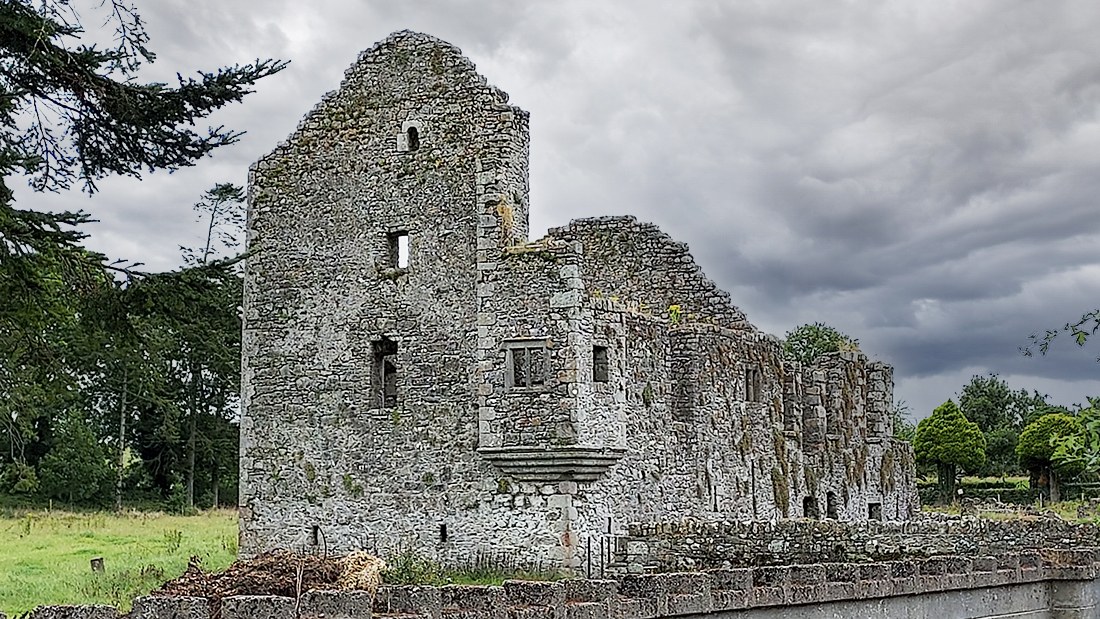
Robertstown | A man called ‘Gutters’ once lived in the castle at Robertstown. He would sit in a window and shoot at passers by, so the local priest (said to be a Plunkett in some tales) who was living in the castle at Ardamagh tried to catch him. The priest watched him for weeks to see if he would leave the castle. One day he spotted Gutters in a field and rode out to him and shot him dead. People passing by would throw a stone on the place were he fell. The blood of some victims of Gutters is said to be visible on the stairs. Original by Patrick O’Brien, Moynalty; The Schools’ Collection, Volume 0705, p. 329
Moybologue | There was an old graveyard in the townland of Mullinastaghan and near it was an old fort where the faeries were supposed to have dwelt. Saint Patrick thought this was an unsuitable place for a Christian graveyard so he decided to move it. He filled a cart with stones and sent it onwards with a donkey. He said wherever the donkey stops to rest that was where the new graveyard was to be built. The donkey stopped on Moybologue Hill and the graveyard has been there ever since.Original by Cristiná Nic an tSaoi, Ballymakane; The Schools’ Collection, Volume 0705, p. 151
Tierworker | Moybologue parish is also known as ‘Tierworker’. It got this name because long ago a fair was held on the side of the mountain and people would play games at it, including spear throwing. In Irish, Tierworker (Taobh Urchair), means ‘side of the throw’ and this is where the name came from. A man was killed at it once when he fell of a horse and got trampled by the rest of the horses. The fair ceased after that and was moved to Muff. Original by Kevin Carolan, Teevurcher;. The Schools’ Collection, Volume 0710, pp. 8-9
Cormeen | There is a burial ground at Bawnbreakey, near Cormeen, known as the ‘potato garden’. Stone masons were building a church there once but when they arrived the next morning all their work had disappeared. The following night the same thing happened again. On the third night a guard was posted there but the work yet again disappeared. A local prophet called Meldrum instructed them that they would never build a church there, but he showed them a place where they could. He brought them to Ervey where the church still stands today. Meldrum also predicted that “A great battle will be fought at Ervey Lake before Ireland gains her freedom” and that “The Spaniards will take part in the battle and the hooves of the horses will tear up the gold out of the ground as they cross the hill”. Original by Máire Finnegan, Cormeen; The Schools’ Collection, Volume 0710, pp. 6-7
Moynalty | There is supposed to be a tunnel that leads from Garryard wood to Kingsfort at the opposite side of Moynalty. Two men were walking through the wood one night and they heard the sound of fiddle music being played beneath the ground. The music seemed to travel in the direction of the village so the men followed all the way to the bridge over the river. The sound faded away here and some people say this is because the tunnel caved in at this point. Original by Patrick O’Brien, Moynalty; The Schools’ Collection, Volume 0705, p. 381
Kilmainhamwood | Another name for Whitewood Lake is ‘The Lady Lake’. It got this name from when years ago, Lady Pratt was riding her white horse home from a ball. She stopped there to give her horse a drink, but as they approached the edge of the water something spooked the horse and they both fell in. Both Lady Pratt and her horse drowned that night, and every night since they have been seen riding around the lake. It is said that if you look into the water on a moonlit night and make a wish you will get anything that you ask for. Original by Peggy Reilly, Screeboge; The Schools’ Collection, Volume 0699, pp. 325-326
References
- Valentine Farrell, Not So Much To One Side (Moynalty, 1984), p. 129
- RTÉ Archives, ‘What lurks beneath the waters of Whitewood Lake?’, News report (1981), Available at https://www.rte.ie/archives/2016/0712/801869-the-monster-of-whitewood-lake (Jun. 20, 2019)
- John T. Koch, Celtic Culture: A Historical Encyclopedia (5 vols., Santa Barbara, 2006), 1, pp. 189-190
- Mark Latham, Hunting the Headless Horseman (New York, 2017), p. 46
- Richard Marsh, Meath Folk Tales (Dublin, 2013), pp. 123-124
- Alastair Kneale, ‘The importance of the hare in Celtic belief and our duty to protect all wildlife’ (Sep. 24, 2017), Available at https://www.transceltic.com/pan-celtic/importance-of-hare-celtic-belief-and-our-duty-protect-all-wildlife (Apr. 4, 2022)
- Gearóid Ó Crualaoich, ‘Continuity and adaptation in legends of Cailleach Bhéarra’ in Béaloideas Iml. 56 (1988), pp. 153-178
- Gary Branigan, ‘Lake of the Physician’ in Cavan Folk Tales (Dublin, 2016)
- Dáithí Ó hÓgáin, The Sacred Isle: Belief and Religion in Pre-Christian Ireland, (Woodbridge and Cork, 1999) p. 214
- Gary R. Varner, Sacred Wells: A Study in the History, Meaning, and Mythology of Holy Wells and Waters (New York, 2009), p. 69
- Oliver Rafferty, Catholicism in Ulster, 1603-1983: An Interpretative History (South Carolina, 1994), pp. 64-65
- Tomás Ó Fiaich, ‘The registration of the clergy in 1704’ in Seanchas Ardmhacha: Journal of the Armagh Diocesan Historical Society, Vol. 6, No. 1 (1971), pp. 46-69
 Beyond the Borora