
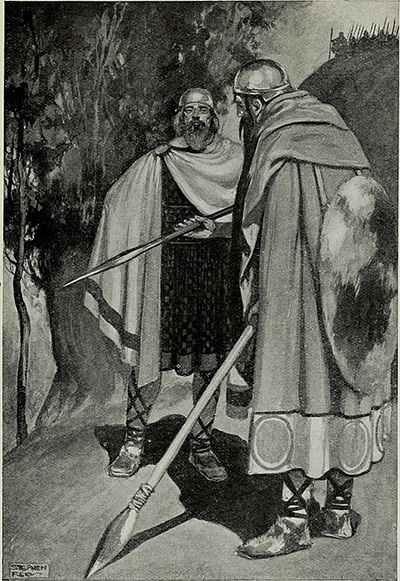
The Tuatha Dé Danann [too-ha-day-don-on] were the gods and goddesses of ancient Ireland who were worshiped as a part of our old pagan religion. It was said that they came from four magical cities to the north called Falias, Gorias, Murias and Findias and brought with them a treasure from each: The Lia Fáil (The Stone of Destiny), the Claíomh Solais (The Sword of Light), the Cauldron of the Dagda and the Spear of Lugh. One of these treasures, the Lia Fail, can still be seen to this day on the Hill of Tara.
The Tuatha Dé gained control of Ireland by firstly defeating the Fir Bolg at the First Battle of Moytura and then the Formorians at the Second Battle of Moytura. The Fir Bolg were likely historical, displaced Celts from Europe,1 while the Fomorians are usually depicted as monsters and are thought to represent an older generation of gods or inhabitants of Ireland.2 The Cailleach, a pre-Celtic goddess associated with Tierworker, may have been a Fomorian as she is sometimes depicted in a similar manner, such as having one eye in the centre of her forehead.3 Interestingly, the townland of Carnacally translates as ‘Cairn na Caillí’, meaning the ‘Grave of the Cailleach’, however this is unlikely to be the goddess and was probably a local witch, which is also ‘cailleach’ As Gaeilge. As for the gods of the Tuatha Dé, it is the sun god, Lugh, who still remains with us locally to some degree. The collecting of bilberries in early August is a remnant of the Celtic festival of Lughnasa,4 and is still practiced around the Loughanleagh Mountains.
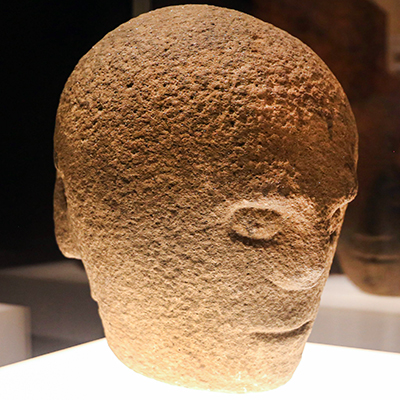
The Tuatha Dé were the last of the god-like peoples to rule over Ireland before the final wave of invaders arrived from Iberia. These were called the Milesians and are thought to be the ancestors of the modern days Gaels. When the Milesians landed they travelled inland towards the royal capital of Tara, and on their travels were appeared to by three sister goddesses of the Tuatha Dé called Banba, Fodla & Ériu, who each asked that Ireland take their name. Their requests were granted but only the name Ériu survived, which later became Éire.
The Milesians eventually defeated the Tuatha Dé at the Battle of Tailteann and agreed to split Ireland with them on one condition: the Milesians were to rule everything above the ground while the Tuatha Dé could have everything below. From then on the Tuatha Dé retreated inside the different hills and mounds around Ireland where they remain to this day. This is where the stories of ‘fairy forts’ originate and is the reason why it is considered bad luck to disturb anything on an ancient monument.
References
- John T. Koch, Celtic Culture, a historical encyclopaedia, Vol. 1, (Santa Barbara & Oxford, 2006), p. 198
- Patricia Monaghan, The Encyclopedia of Celtic Mythology and Folklore (New York, 2004), p. 198
- Charles Russell Coulter, Patricia Turner, Encyclopedia of Ancient Deities (Jefferson, 2000), p. 112
- Seamus MacGabhann, ‘Landmarks of the people: Meath and Cavan places prominent in Lughnasa mythology and folklore’ in Riocht na Midhe 11 (2000), pp. 221-222
 Beyond the Borora